
A conversation that starts with a capex cut — “the floor is too expensive,” “we already stopped the refresh,” “exit is just lift and shift” — usually fails at the first workload no one inventoried, the first contract still in term, or the first cutover with no rollback owner, not at the first headline. A capex cut is a budget line. It is not a data center exit readiness plan.
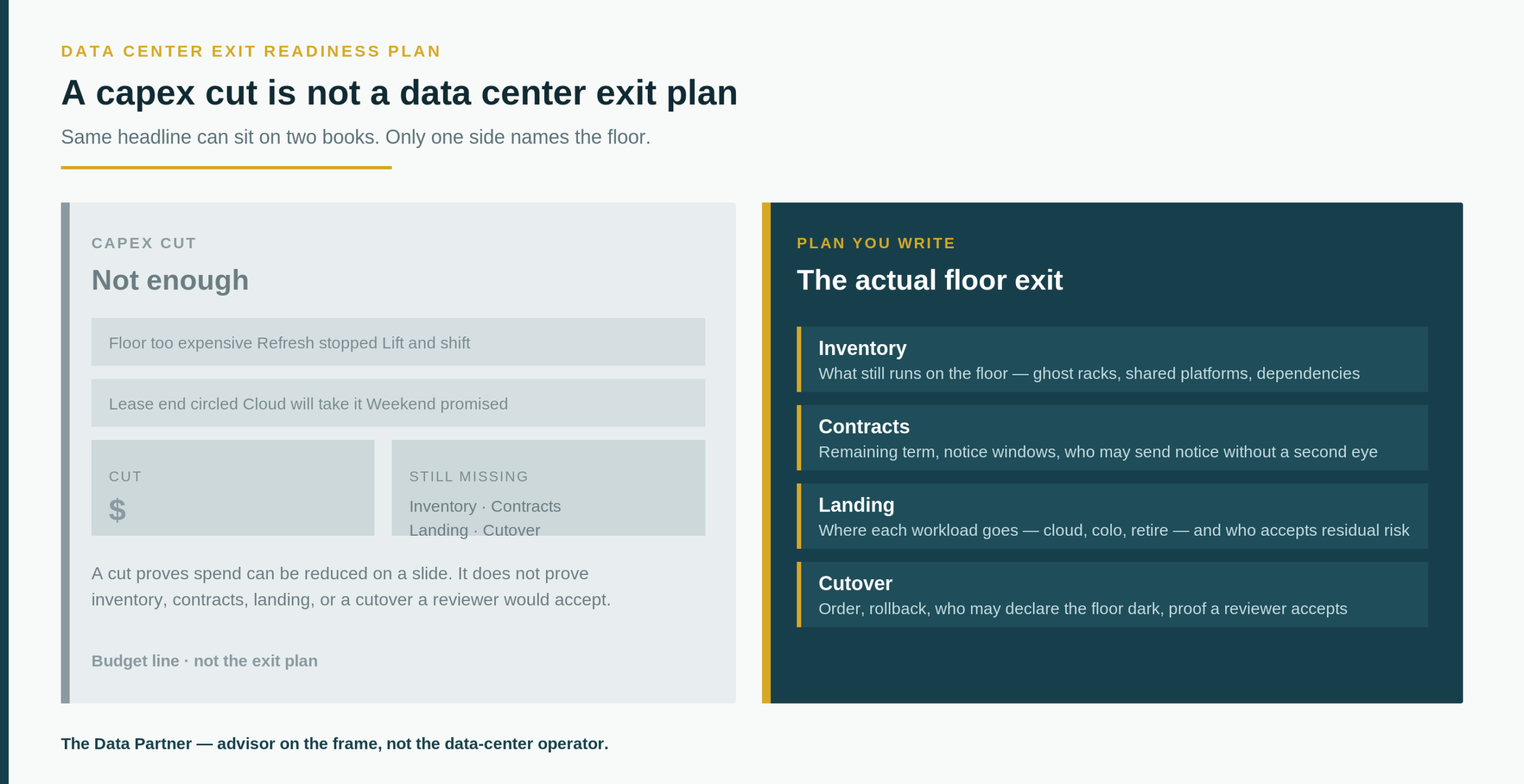
A data center exit readiness plan names what still runs on the floor, which contracts and notice windows bind you, where each workload lands, and the cutover a later reviewer would accept as done. It does not name a capex cut. It does not name a lift-and-shift slogan. Two buyers can share the same headline and still miss a ghost rack, miss a colo notice window, land a workload with no owner, and have nothing that proves the floor went dark on purpose.
The usual shortcut collapses the exit into a cut. Someone stops a refresh, circles a lease end date, and treats that headline as the plan. Inventory is still unread. Contracts still auto-renew. Landing is still “the cloud will take it.” Cutover is still a promised weekend. You have a capex cut. You do not have a data center exit readiness plan.
That is why the live colocation provider page starts with stay on the floor versus place a workload with an operator rather than a lease headline. This note does not replace that page. It is the data-center-exit reminder that sits beside it: a capex cut is not the plan. When the next job is still whether a move, a stay, or an exit is even the work, use the cloud assessment after the inventory, contracts, landing, and cutover rows are written, not instead of them. Score written answers on the cloud provider evaluation. If the next argument is “the provider secures the cloud,” use the cloud security responsibility matrix — that is identities, keys, and logs, not an exit order. Isolated-copy work sits on backup as a service — a different job.
What a data center exit readiness plan is not
- It is not a capex cut. A budget line proves spend can be reduced on a slide. It does not prove inventory, contracts, landing, or cutover.
- It is not a lift-and-shift slogan. A migration phrase is not a named landing or a rollback owner.
- It is not a colocation brief. Stay-versus-place is a sibling job. It is not the exit packet on this page.
- It is not a cloud assessment. Whether a move is even the work is a different brief. It is not the floor you are leaving.
- It is not a backup copy. Isolated restore is a different job. It is not proof the floor went dark on purpose.
What to write before the capex cut
- Inventory: what still runs on the floor, including ghost racks, shared platforms, and dependencies no one billed as a workload.
- Contracts: remaining term, notice windows, colo and power riders, and who may send notice without a second eye.
- Landing: where each workload goes — cloud, colo, retire — and who accepts residual risk on an unplaced system.
- Cutover: order, rollback, who may declare the floor dark, and what evidence a later reviewer would treat as done.
- Remainder: what still has to live near the building, and who owns that remainder after the exit invoice.
Questions that belong in the first meeting
Ask the incumbent or a challenger to show, not describe:
- Which floor systems they treated as inventoried, and which they treated as “the capex cut already covers it.”
- A contract still in term, the notice window, and who may send that notice.
- Where a named workload lands, and an example cutover where the rollback was actually used.
- What a later reviewer would receive as exit proof — not a capex headline and a promised migration week.
If those answers are a capex cut and a promised exit week, you do not have a data center exit readiness plan. You have a budget line.
What this page is not
This is not a platform ranking, not a migration product sheet, and not a claim that The Data Partner already operates anyone’s floor after a catalog view. The Data Partner is the advisor on the decision frame, not the data-center operator and not the cloud vendor. It is not a reprint of the live colocation brief, the live cloud assessment, the live provider evaluation, the live security-responsibility matrix, or the live backup brief. Skip incentive talk and skip any suggestion that a capex cut defines an exit. Write inventory, contracts, landing, and cutover for the floor you are leaving. Then use the live companions, or contact The Data Partner on that packet. Broader buying questions sit on the FAQs page.