
September 12, 2026
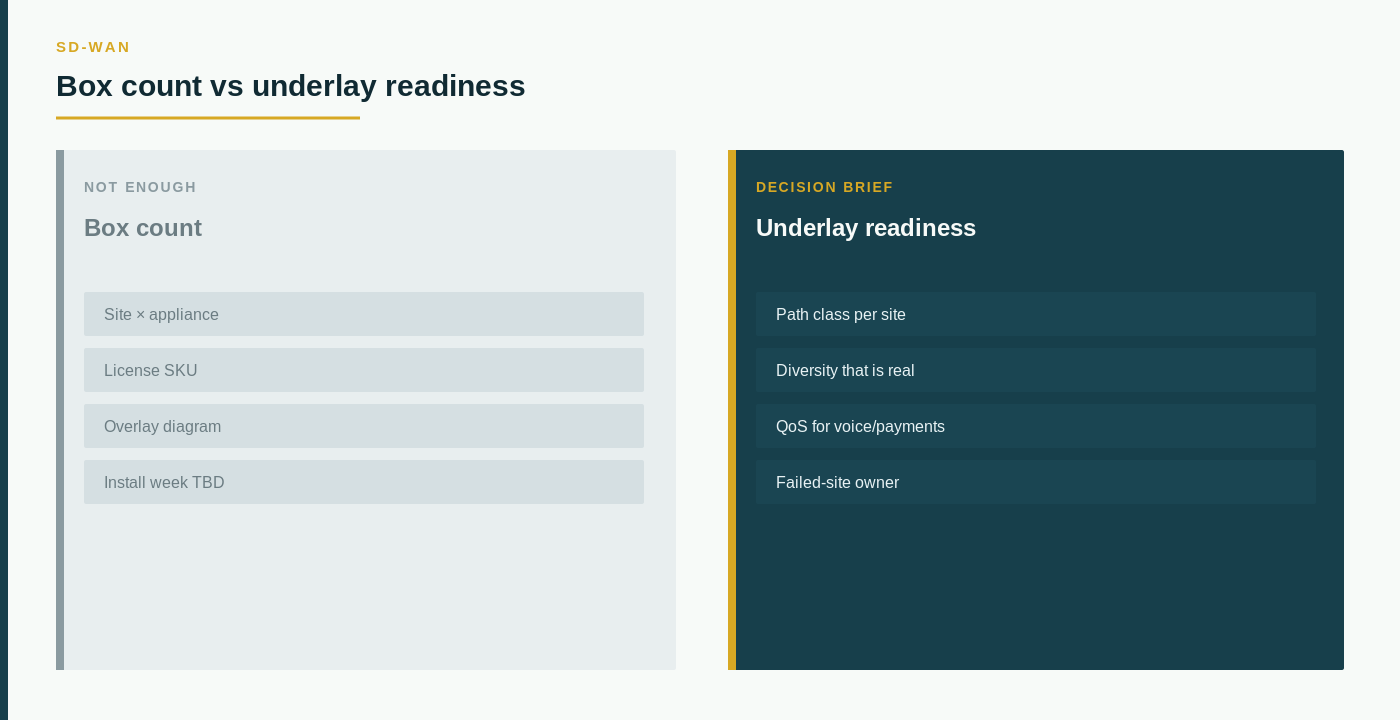
Concise answer: A box count is a procurement still — sites times appliances, a license SKU, an overlay diagram, an install week. SD-WAN underlay readiness is an operating decision: which path class each site actually has, whether diversity is real, what QoS voice and payments require, and who owns a failed site. Treat the box count as one input. Do not treat it as readiness.
Overlay diagrams are good at drawing tunnels. They are not designed to tell you whether the next site still has a path underneath.
The central principle is simple: a box count is an appliance tally, while underlay readiness is an operating decision. Those questions are related. They are not interchangeable.
This page is an underlay readiness brief, not an SD-WAN product family. A circuit map, a firewall refresh, or an SD-WAN SKU can inform the buy — they do not replace the underlay. Do not collapse this note into “An SD-WAN Assessment Is Not a Circuit Map,” “An SD-WAN SKU Is Not an SD-WAN vs. SASE Decision,” or “A Firewall Refresh Is Not an SD-WAN Provider Decision.” Those are category and provider conversations. This one is about the paths the boxes must ride.
What a box count actually tells you
A box count usually arrives as a BOM, a “one appliance per site” table, or a slide that shows tunnels over a blank underlay. It can be useful. It tells you how many devices someone intends to ship.
It does not tell you whether those devices will have independent paths, usable QoS, or an owner when a site is dark.
A box count may represent:
- A license that assumes two underlays the building does not have.
- A single broadband circuit drawn as “DIA plus LTE later.”
- An overlay that still shares an entrance, a power feed, or an upstream.
- An install week that never reserved landlord or construction time.
- A QoS promise that the underlay provider will not honor.
A tally is not a path class. A tunnel is not diversity. The useful question is not “How many boxes?” It is “Which underlay is true at each site, what failure that path survives, and who owns the site when it does not?”
The SD-WAN assessment is the right place to reset the decision before you argue about appliance count.
Separate the tally from the underlay brief
A box count does not show whether the overlay is operable.
Important questions remain open even when the BOM looks complete:
- Which sites have a written path class — DIA, broadband, fixed wireless, cellular — and which are still “TBD”?
- What last-mile, entrance, and power each pair still shares?
- What voice and payments require of latency, jitter, and loss on the real underlay?
- Who is paged when a site is dark, and whether the backup path was ever pulled?
- What the landlord, construction, and order lead times do to the install week?
A BOM cannot answer these questions because it is not designed to capture them.
Compare the box count with the underlay brief
| Decision area | What a box count may show | What underlay readiness must document |
|---|---|---|
| Decision identity | Appliances × sites | Whether this is a replacement, a dual-underlay build, or a lab overlay |
| Path class | Sometimes “DIA + LTE” | The path that is ordered, not the path on the slide |
| Diversity | Two arrows | Entrance, power, and upstream that are actually independent |
| QoS | Overlay markings | What the underlay will honor for voice and payments |
| Ownership | A NOC badge | Who owns a failed site, including after hours |
| Timing | Install week | Landlord, construction, and a test that is not the go-live |
Two BOMs can show the same box count and still describe different networks. One may have two independent underlays on paper and in the building. The other may have two logos on one riser.
Write the underlay before you ship the boxes
Start with the site record, not the SKU.
Write one record for underlay readiness:
- Decision identity: replace, dual-underlay, or overlay-on-what-you-have; why now; who owns the outcome.
- Path class per site, including what is still an estimate.
- Diversity that names shared facilities, not brand names.
- QoS and application proofs that will be timed, not assumed.
- Failed-site owner and the next test date.
The SD-WAN meaning page is the companion when the category is still a circuit map. SD-WAN providers is the companion when the next job is a shortlist after the underlay rows exist. SD-WAN vs MPLS is the companion when the argument is still a faster circuit.
Questions that belong in the first meeting
Ask the incumbent or a challenger to show, not describe:
- Which sites they treated as dual-underlay, and which they treated as “the box count already includes LTE.”
- A shared entrance or power they actually named, not two brand logos.
- How voice or payments behave when the primary underlay is pulled.
- What a later reviewer would receive as readiness proof — not a box count and a promised overlay week.
If those answers are a box count and a tunnel slide, you do not have SD-WAN underlay readiness. You have a tally.
What this page is not
This is not an SD-WAN ranking, not an appliance product sheet, and not a claim that The Data Partner already overlaid anyone’s sites after a catalog view. Skip incentive talk and skip any suggestion that a box count defines readiness. Write path class, diversity, QoS, and failed-site ownership for the work you are buying. Then use the live companions, or contact The Data Partner on that packet. Broader buying questions sit on the FAQs page.