
September 12, 2026
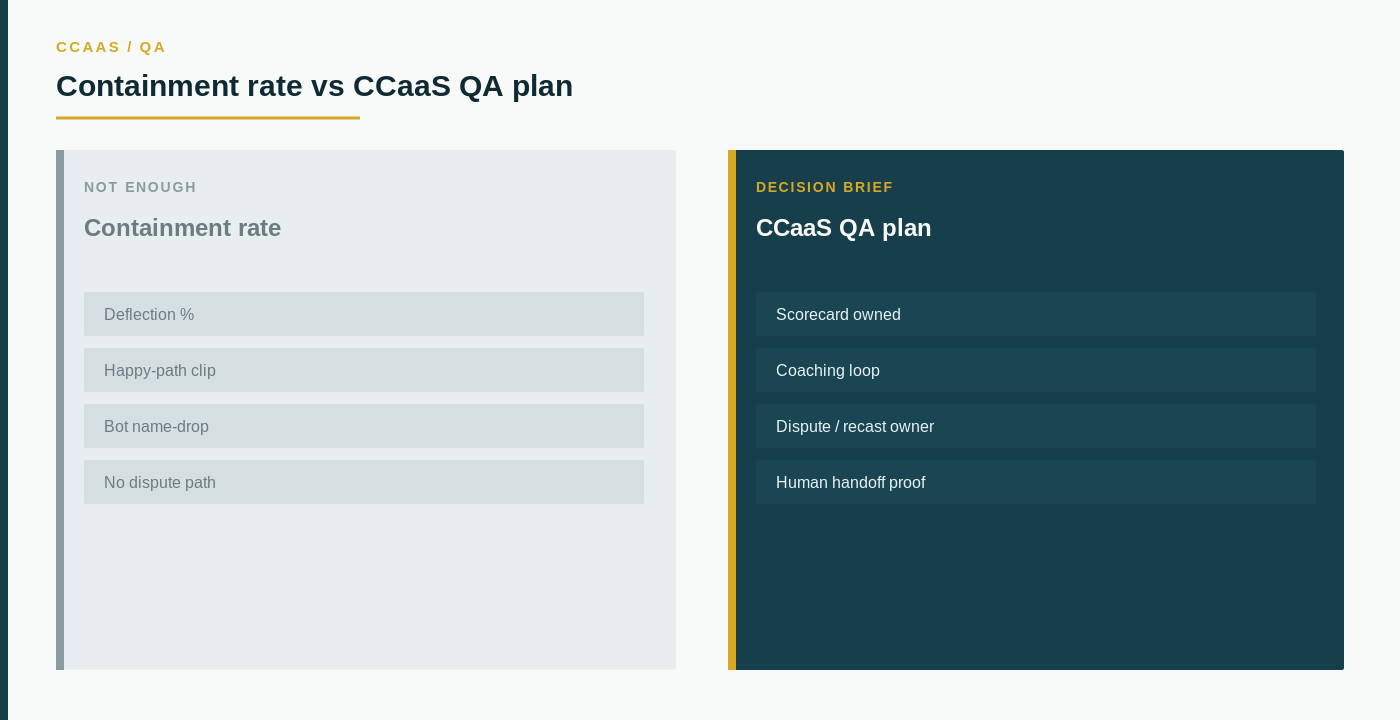
Concise answer: A containment rate is a bot still — a deflection percentage, a happy-path clip, a model name, a slide that never shows a dispute. A CCaaS QA plan is an operating decision: who owns the scorecard, how coaching happens, who recasts a disputed contact, and what proof means a human handoff occurred. Treat containment as one input. Do not treat it as the QA plan.
Bot dashboards are good at showing deflection. They are not designed to tell you whether the next contact was scored, coached, or owned.
The central principle is simple: containment is a deflection artifact, while CCaaS QA is an operating decision. Those questions are related. They are not interchangeable.
This page is a CCaaS QA plan, not a bot-demo note. A guardrail brief, a QM scorecard, or a channel map can inform the conversation — they do not replace the plan that sits on top of containment. Do not collapse this note into “A Bot Demo Is Not Contact Center AI Guardrails,” “A Scorecard Is Not a Quality Brief,” or “A Channel Map Is Not Omnichannel.” Those are guardrail, QM-meaning, and channel conversations. This one is about whether QA still exists when the bot is “winning.”
What a containment rate actually tells you
A containment rate usually arrives as a weekly tile, a “we deflected 42%” QBR, or a clip of a bot finishing a password reset. It can be useful. It tells you how often a contact never reached a person.
It does not tell you whether that contact was correct, coachable, or recoverable when the customer disagrees.
A containment rate may represent:
- Happy-path scripts that never meet an angry, silent, or regulated caller.
- Contacts closed because the bot ended the session, not because the work finished.
- A model name that substitutes for a scoring rubric.
- No path to dispute, recast, or reopen the contact.
- A handoff that dumps context and still counts as contained.
A percentage is not a scorecard. A clip is not a coaching loop. The useful question is not “How high is containment?” It is “Who scores the contact, who coaches, who recasts a dispute, and what proves a human actually received the work?”
The contact center quality management requirements page is the right place to reset QA before you argue about deflection.
Separate containment from the QA plan
A containment rate does not show whether CCaaS QA is operable.
Important questions remain open even when the tile looks strong:
- Which contacts are in the QA sample — bot-only, handoff, or both?
- Who owns the scorecard, and does the same rubric apply after a bot turn?
- How a disputed contact is recast, and who may reopen it?
- What coaching happens when the bot was confident and wrong?
- What evidence proves a human handoff kept context?
A deflection tile cannot answer these questions because it is not designed to capture them.
### Compare the rate with the QA plan
| Decision area | What a containment rate may show | What the CCaaS QA plan must document | |—|—|—| | Decision identity | Deflection % | Whether QA covers bot, human, or the handoff between them | | Scorecard | Sometimes a CSAT tile | Rubric, sample, and who calibrates it | | Coaching | A “bot improved” note | Loop, owner, and what changes in the next week | | Dispute | None | Who recasts, who reopens, what the customer receives | | Handoff | Contained / not | Context that survives, and a fail-closed when it does not | | Evidence | A clip | File a later reviewer would accept |
Two tiles can show the same containment and still describe different floors. One may score bot and human on one rubric. The other may hide misses inside a deflection win.
Write the QA plan before you celebrate the rate
Start with the contact, not the model name.
Write one record for the CCaaS QA plan:
- Decision identity: bot QA, human QA, or the shared handoff; why now; who owns the outcome.
- Scorecard and sample that include contained contacts, not only agent calls.
- Coaching loop with a named owner and a next-week change.
- Dispute and recast path the customer can actually use.
- Handoff proof that is fail-closed when context dies.
The CCaaS meaning page is the companion when the category is still a queue demo. Compare CCaaS platforms is the companion when the next job is a shared script after the QA rows exist. The live bot demo is not contact-center AI guardrails note is the companion when the open question is still ownership and fail-closed, not QA sampling.
Questions that belong in the first meeting
Ask the incumbent or a challenger to show, not describe:
- Which contained contacts they scored, and which they treated as “the rate already proves quality.”
- A dispute they recast, including who owned it and what the customer received.
- A handoff that kept context, and a handoff that failed closed.
- What a later reviewer would receive as QA proof — not a containment rate and a promised bot quarter.
If those answers are a containment rate and a happy-path clip, you do not have a CCaaS QA plan. You have a deflection tile.
What this page is not
This is not a CCaaS ranking, not a bot product sheet, and not a claim that The Data Partner already QAs anyone’s queue after a catalog view. Skip incentive talk and skip any suggestion that a containment rate defines QA. Write scorecard, coaching, dispute, and handoff for the work you are buying. Then use the live companions, or contact The Data Partner on that packet. Broader buying questions sit on the FAQs page.