
September 12, 2026
Concise answer: A cage quote is a facility still — cabinet kW, a cross-connect count, an MMR photo, a “cloud on-ramp later” line. A hybrid interconnect design is an operating decision: which workloads must land in the cage, which cloud path and exit they ride, what latency the work requires, and who operates the result. Treat the quote as one input. Do not treat it as the design.
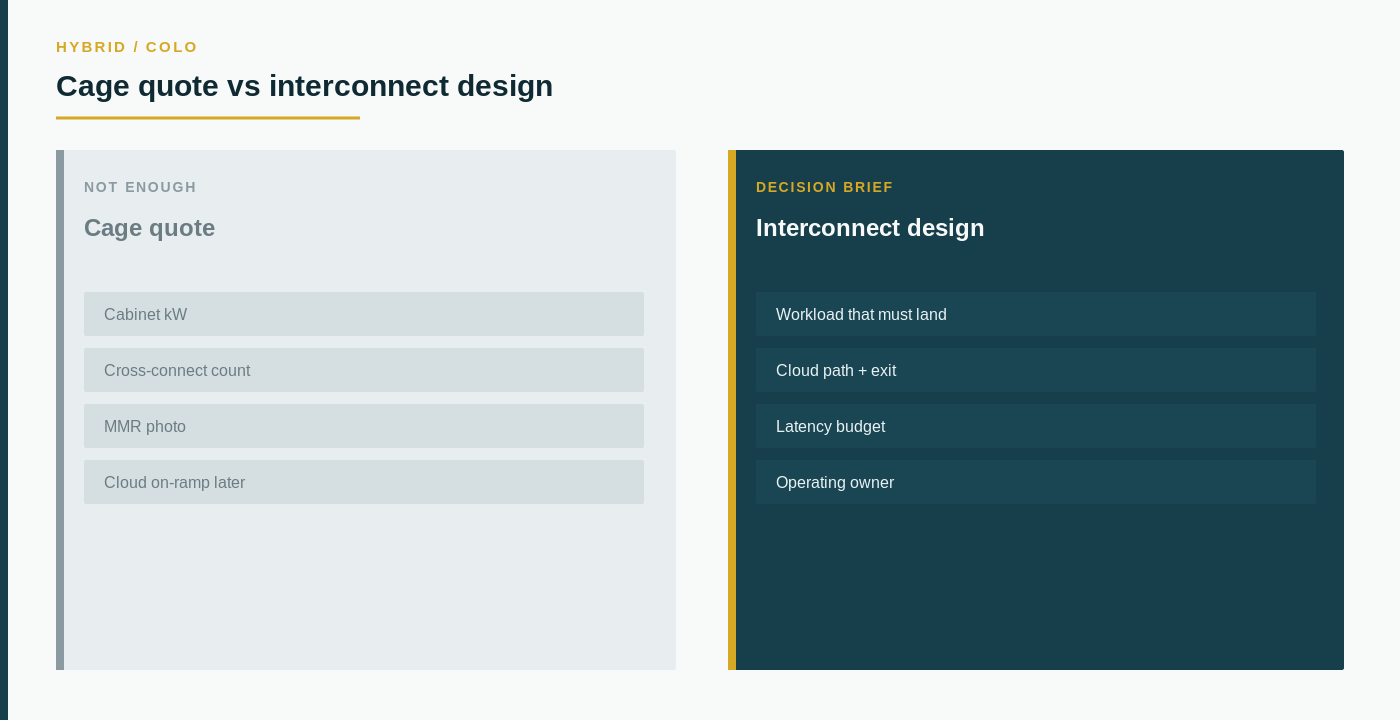
Cage quotes are good at pricing power and space. They are not designed to tell you whether the next workload still has a path to the cloud.
The central principle is simple: a cage quote is a facility artifact, while hybrid interconnect is an operating decision. Those questions are related. They are not interchangeable.
This page is a hybrid interconnect design brief, not a colo brochure and not the three-way placement note. A cabinet photo, a logo wall, or a data-center exit plan can inform the conversation — they do not replace the interconnect. Do not collapse this note into “A Cabinet Photo Is Not a Colocation Provider Decision,” “A Logo Wall Is Not a Cloud Placement,” or “A Capex Cut Is Not a Data Center Exit Plan.” Those are facility, placement, and exit conversations. This one is about the path between the cage and the clouds you already named.
What a cage quote actually tells you
A cage quote usually arrives as a kW and cabinet table, a cross-connect price list, or a tour photo of the meet-me room. It can be useful. It tells you a facility can be billed.
It does not tell you whether the workload can land, leave, or stay within a latency budget.
A cage quote may represent:
- Power and space that assume a cloud on-ramp someone has not ordered.
- Cross-connect counts that never name the far-end cloud region.
- An MMR photo used as proof of interconnect.
- “Hybrid later” as a substitute for an exit and a latency budget.
- A facility term that outlives the cloud path you thought you were buying.
A kW number is not a workload class. A cross-connect is not an operating owner. The useful question is not “How cheap is the cage?” It is “Which work must land here, which cloud path it rides, what leaving costs, and who is paged when that path is impaired?”
The colocation provider page is the right place to reset the facility brief before you argue about the interconnect.
Separate the quote from the interconnect brief
A cage quote does not show whether hybrid interconnect is operable.
Important questions remain open even when the kW looks right:
- Which workloads must land in the cage, and which are still “the cloud will take it”?
- Which cloud path is ordered — private interconnect, VPN, or a hoped-for on-ramp?
- What latency, jitter, and loss the work requires, and whose clock wins a dispute?
- What exit from the cage and from the cloud actually costs, and who may approve it?
- Who operates identity, routing, and an impaired morning across both sides?
A facility quote cannot answer these questions because it is not designed to capture them.
### Compare the quote with the interconnect brief
| Decision area | What a cage quote may show | What the interconnect design must document | |—|—|—| | Decision identity | kW and cabinets | Whether this is land, leave, or a temporary plus permanent path | | Workload | Sometimes a “hybrid” label | Apps that must sit in the cage, and why | | Cloud path | On-ramp later | Ordered path, region, and what fails if it is down | | Latency | Rarely | Budget the work recognizes, not a tour claim | | Exit | Term on the cage | Cage exit and cloud exit, with owners | | Operations | Remote hands SKU | Who is paged across cage and cloud |
Two quotes can show the same kW and still describe different designs. One may have a named cloud path and a timed owner. The other may have a photo of the MMR and a promise.
Write the interconnect before you sign the cage
Start with the workload, not the cabinet.
Write one record for the hybrid interconnect:
- Decision identity: land, leave, or bridge; why now; who owns the outcome.
- Workload class that must sit in the cage, with a reason a later reviewer would accept.
- Cloud path that is ordered, including region and fail behavior.
- Latency budget and the test that will prove it.
- Operating owner across both sides, including the first impaired morning.
The cloud assessment is the companion when the placement decision is still a logo wall. Cloud provider evaluation is the companion when the next job is scoring an operator after the interconnect rows exist. The data center exit readiness plan is the companion when the work is leaving a hall, not lighting a hybrid path.
Questions that belong in the first meeting
Ask the incumbent or a challenger to show, not describe:
- Which workloads they treated as landing in the cage, and which they treated as “the quote already includes hybrid.”
- A cloud path that is ordered, not an MMR photo.
- A latency budget they will prove, and whose clock wins.
- What a later reviewer would receive as interconnect proof — not a cage quote and a promised on-ramp quarter.
If those answers are a cage quote and a meet-me-room photo, you do not have a hybrid interconnect design. You have a facility still.
What this page is not
This is not a colo ranking, not a cloud product sheet, and not a claim that The Data Partner already lit anyone’s hybrid path after a catalog view. Skip incentive talk and skip any suggestion that a cage quote defines interconnect. Write workload, cloud path, latency, and owner for the work you are buying. Then use the live companions, or contact The Data Partner on that packet. Broader buying questions sit on the FAQs page.