
A conversation that starts with a runbook PDF — “we have the DR document,” “here is last year’s tabletop,” “recovery is in the binder” — usually fails at the first unnamed restore objective, the first morning no one may declare, or the first failback that was never dated, not at the first cover page. A runbook PDF is a file. It is not disaster recovery as a service requirements.
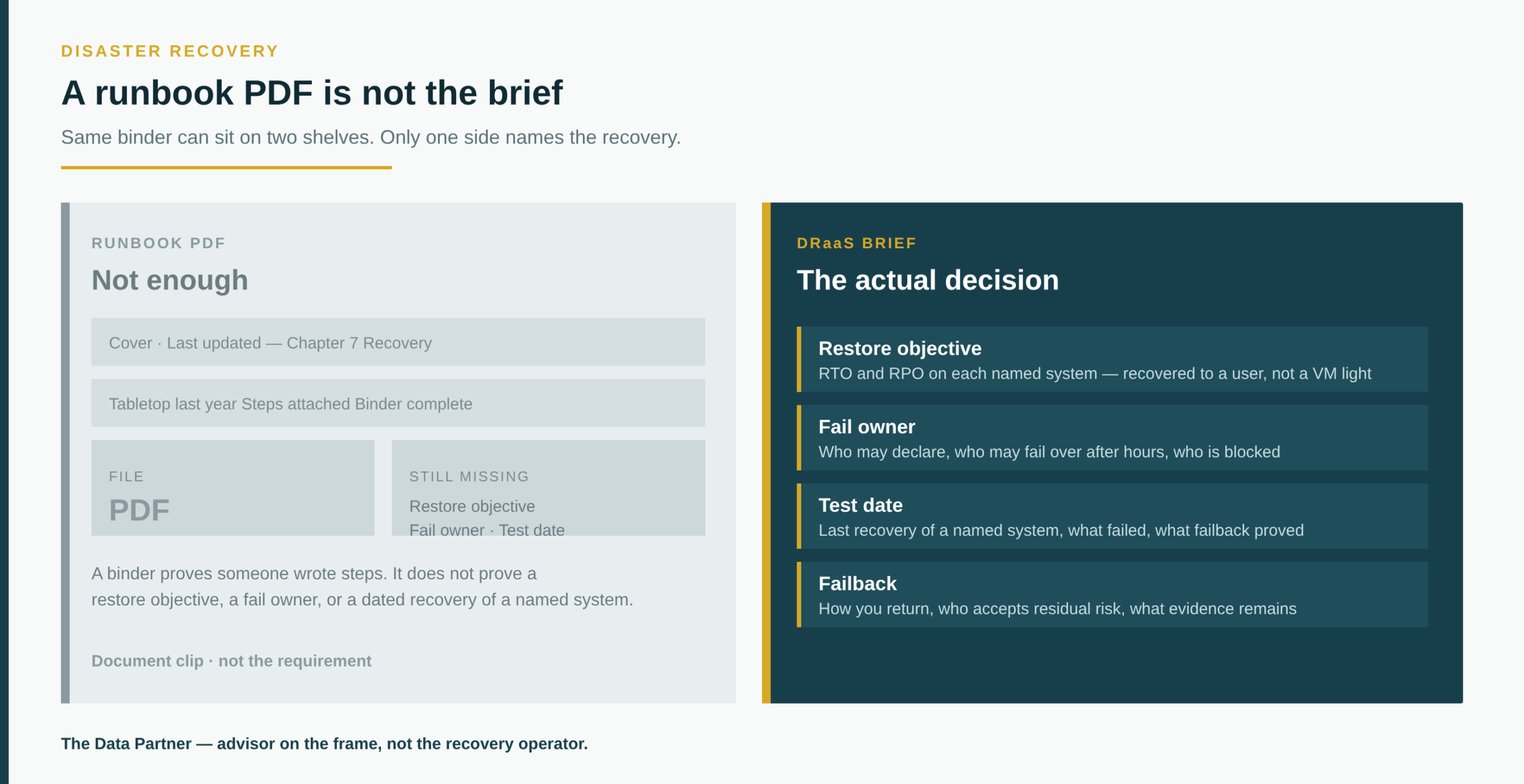
Disaster recovery as a service requirements name which running workloads must come back, in what restore objective, who may declare a fail, who owns the failback, and the last date that sequence was tested on a named system. They do not name a binder. They do not name a tabletop slide. Two tenants can share the same PDF and still recover different systems, leave declaration unowned, skip a dated test, and have nothing a later reviewer would accept as a completed recovery.
The usual shortcut collapses recovery into a document. Someone attaches the runbook, points at a recovery-time sentence, and treats that file as the requirement. The isolated-copy question is still unread — that is backup, not recovery of a running service. Compute, identity, and the path that must stand up are still a hope. Failover has a chapter and no owner. Failback has no date. You have a PDF. You do not have DRaaS requirements.
That is why the live backup as a service page starts with an isolated copy and a named restore rather than a folder tree. This note does not replace that page. Backup is a copy. DRaaS is the recovery of a running service. When the next job is still which practices belong on a list, use the backup and TEM comparison after the restore objective and fail owner are written, not instead of them. Score the written packet on the backup and TEM assessment. If the open question is still which cloud workloads and tests remain yours, use the cloud assessment before anyone treats a binder as the architecture. Invoice and inventory match sit on telecom expense management — a different job.
What DRaaS requirements are not
- They are not a runbook PDF. A binder proves someone wrote steps. It does not prove a restore objective, a fail owner, or a dated test.
- They are not a tabletop slide. Talking through a scenario is rehearsal language. It is not a recovered named system.
- They are not backup as a service. An isolated copy is necessary material. It is not the recovered compute, identity, and path.
- They are not a logo comparison. A familiar recovery SKU does not write your declaration rule or your failback date.
- They are not an invoice match. TEM can tell you what you pay. It cannot tell you what comes back.
What to write before the binder
- Workloads in and out: which running systems must recover, which wait, and which are out of scope. A “critical apps” sentence is not that list.
- Restore objective: the RTO and RPO you will accept on each named system, and what “recovered” means to a user, not a VM light.
- Fail owner: who may declare, who may fail over without a second call, and who is blocked after hours.
- Test date: the last recovery of a named system, what failed, and what failback proved. An undated PDF is not a test.
- Failback: how you return, who accepts residual risk, and what evidence remains.
- Remainder: what stays internal after the DRaaS invoice — identity, network, communications, and the owner of an incomplete recovery.
Questions that belong in the first meeting
Ask the incumbent or a challenger to show, not describe:
- Which running systems they treated as in the recovery, and which they left as “restore the files and we will rebuild.”
- The restore objective they will accept on a named system, and a dated test that met or missed it.
- Who may declare and who may fail back, including after hours.
- What a later reviewer would receive — objective, owner, test date — not a runbook PDF.
If those answers are a runbook PDF and a promised recovery week, you do not have disaster recovery as a service requirements. You have a binder.
What this page is not
This is not a platform ranking, not a DRaaS product sheet, and not a claim that The Data Partner already recovered anyone’s running service after a catalog view. The Data Partner is the advisor on the decision frame, not the recovery operator and not the backup vendor. It is not a reprint of the live backup-as-a-service page, the live comparison, the live assessment, the live cloud assessment, or the live TEM brief. Skip incentive talk and skip any suggestion that a runbook PDF defines DRaaS. Write the restore objective, the fail owner, the test date, and the failback. Then use the live companions, or contact The Data Partner on that packet. Broader buying questions sit on the FAQs page.