
An advisor shortlist for backup versus TEM that opens on a Hub collage is still screening brands, not comparing practices. Untested restores and unmatched inventory stay off the page until someone writes isolation, a named restore, contract match, and who owns the next action. A logo grid is a screening collage. It is not backup versus TEM.
This page is the first shortlist brief for the Backup and TEM cluster. It is not a ranked list of backup platforms and not a TEM product sheet. The live backup as a service page is the companion when the first job is still what an isolated copy plus a tested restore is, not which logo to pick. The live telecom expense management page is the companion when the first job is still what inventory, contract match, and an owned action are. This page does not replace either. Those pages are meaning. This page is the reminder that a Hub wall is not that shortlist. When the next job is still to write the scorecard, use the live backup and TEM assessment.
Why a logo grid is not a comparison
A logo grid proves that product families exist in a category. It does not prove isolation, restore ownership, inventory, or a dispute clock. Five backup brands can still leave the live tenant as the only copy and leave no one who has restored a named system. Five TEM brands can still leave ghost lines, unused DIDs, and a mobility pool no one owns. Naming another operator does not create a comparison. It creates another slide unless you write the work each practice must carry and keep the columns from collapsing into one collage.
A Supplier Matrix or Hub catalog view has the same limit. It is a screen. It can show that backup-shaped offerings exist among Cloud, Security, and Colocation, and that TEM-shaped offerings exist among TEM, Voice, UCaaS, and Wireless. It cannot name your systems of record, the restore window you will accept, your inventory, your dispute clock, or the information that must stay out of an uncontrolled first form. Treat the catalog as an outbound screen, not as the shortlist. The Data Partner is the advisor on that frame, not the backup operator and not the invoice processor.
The usual shortcut also collapses unlike work. Someone asks for “backup and TEM,” receives a folder tree and a bill export, and treats those artifacts as the comparison — or receives a second circuit and treats path failover as backup as a service. Those are inputs. They are not the shortlist. Path design is a different job from data restore. A payment file is a different job from TEM. The live cloud assessment is the companion when restore tests, placement, and buyer-owned controls are still unwritten. The live business internet assessment is the companion when a path is being scored as if it were the backup shortlist. This page does not replace either. It stays on the Backup and TEM shortlist those pages feed.
What to write before the collage
- Decision identity: replace a folder tree, add an isolated copy, stand up TEM, renew a TEM practice, or stop treating a bill export as the practice — plus who approves technical, commercial, and operating choices.
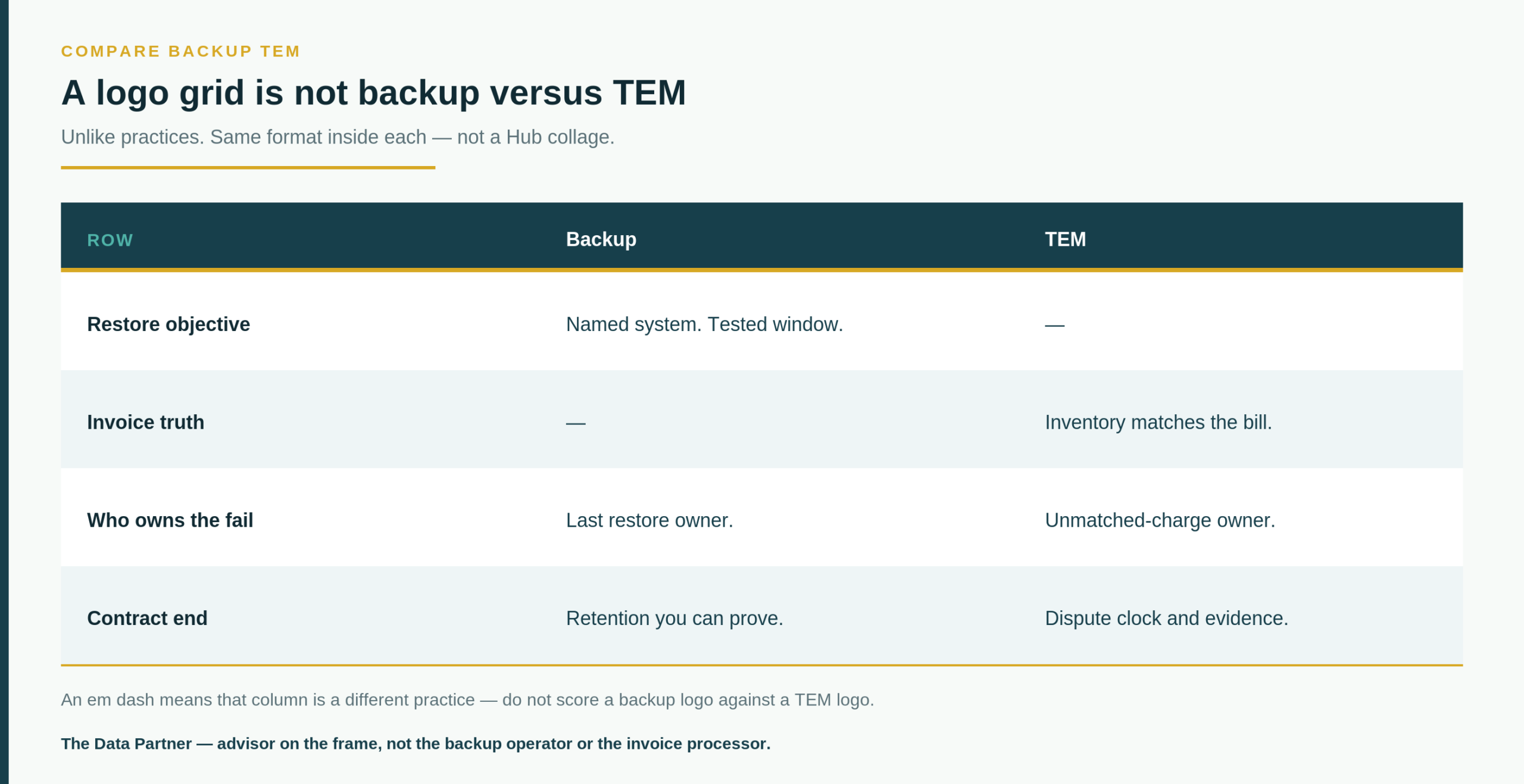
- Backup columns: systems of record in and out, isolation from the live tenant, retention you can prove, the restore window you will accept, the last restore that was actually run, and the named owner. A sync icon is not a column.
- TEM columns: inventory matched to the invoice, contracted rate versus billed rate, unused or ghost services, the dispute clock and evidence, and MACD or disconnect proof. A CSV is not a column.
- Unlike work kept apart: do not score a backup logo against a TEM logo. Same comparison format inside each practice — included, optional, exception, assumption, or customer responsibility — not a monthly number against unlike scope.
- What stays out of the first form: tenant exports, full CDR dumps, and any uncontrolled packet. The catalog cannot name that boundary.
- Operations: who runs the next restore, who matches the next invoice, and what evidence a later reviewer would accept.
Questions that belong in the first meeting
Ask the incumbent or a challenger to show, not describe:
- Which systems and which billed services they treated as in scope, and which they excluded from the collage or treated as a later project sitting beside the quote.
- For backup: where the copy sits relative to the live tenant, who last restored a named system, and what failed.
- For TEM: which inventory row matches which charge, which contract term matches which rate, and which unused service still has no owner.
- Who owns the next restore morning and the next unmatched invoice, and how they keep the same columns so a catalog view is not compared to a service.
If those answers are a logo grid and a promised storage total or credit slide, you do not have a backup and TEM comparison. You have a collage.
What this page is not
This is not a platform ranking, not a backup brochure, not a TEM product sheet, and not a claim that The Data Partner already restored anyone’s tenant or recovered anyone’s spend after a Hub view. It is not a reprint of the live backup-as-a-service meaning page or the live TEM meaning page, and it is not internet failover design. The Data Partner is the advisor on that frame, not the backup operator and not the invoice processor. Skip incentive talk, skip logo grids as a substitute for owners, and skip any suggestion that a brand collage replaces a shared brief. Write the rows. Then request comparable replies. If you want a second set of eyes on the brief, contact The Data Partner on that packet. Broader buying questions sit on the FAQs page.