
A conversation that starts with a rate card — “here is the per-line price,” “unlimited is included,” “coverage is national” — usually fails at the first indoor desk the map cannot reach, the first personal line still carrying corporate mail, or the first failed handset with no replacement owner, not at the first row. A rate card is a price list. It is not a business mobility provider.
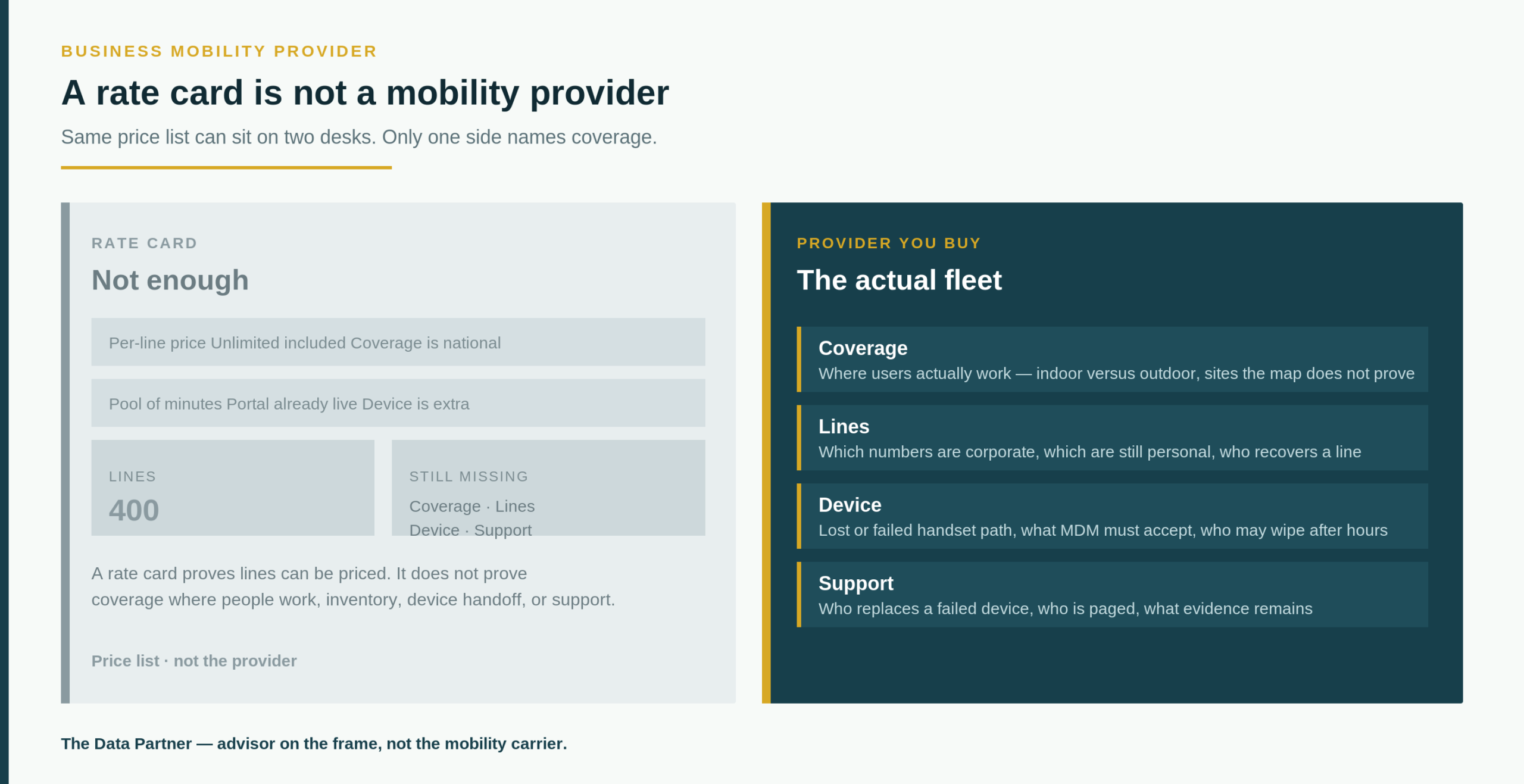
A business mobility provider names where users actually work, which lines are corporate, how a lost or failed device is handled, and who owns an impaired morning. It does not name a rate card. It does not name a national coverage badge. Two buyers can share the same price list and still leave indoor coverage unread, mix personal and corporate lines, leave MDM unowned, and have no one who may replace a handset after hours.
The usual shortcut collapses the provider into a row. Someone opens the rate card, circles unlimited, and treats that price as the decision. Coverage at the desk was never walked. Lines are still “everyone already has a phone.” Device handoff is still a hoped-for portal. Support is still a call-center hour on a slide. You have a rate card. You do not have a business mobility provider.
That is why the live 5G business connectivity page starts with 5G as a path class rather than a faster SKU. This note does not replace that page. It is the mobility-provider reminder that sits beside it: a rate card is not the provider. When the site itself is a radio path, use fixed wireless for business — that is a designed install, not a handset line. If the first job is still the work the path must carry, use the business internet assessment. Device and SIM work for things, not people, sits on IoT connectivity requirements.
What a business mobility provider is not
- It is not a rate card. A price list proves lines can be billed. It does not prove coverage, inventory, device handoff, or support.
- It is not a national coverage badge. A map tile is not indoor coverage at the desk, the warehouse, or the job site.
- It is not 5G as a product family. A radio generation is not the corporate-line provider.
- It is not fixed wireless for a site. A designed radio install is a different brief. It is not a handset fleet.
- It is not IoT connectivity. SIMs for things are a different job. They are not the people on this page.
What to write before the rate card
- Coverage: where users actually work, indoor versus outdoor, and which sites the map does not prove.
- Lines: which numbers are corporate, which are still personal, and who owns a line that must be recovered.
- Device: how a lost or failed handset is handled, what MDM must accept, and who may wipe after hours.
- Support: who replaces a failed device, who is paged on an impaired morning, and what evidence remains.
- Remainder: what the internal team still owns after the mobility invoice — identity, apps, and residual risk on an unmapped line.
Questions that belong in the first meeting
Ask the incumbent or a challenger to show, not describe:
- Which work sites they treated as covered, and which they treated as “the rate card already includes national.”
- A line inventory that separates corporate from personal, and how a departed user is recovered.
- What happens to a lost device after hours, including who may wipe and what they leave behind.
- What a later reviewer would receive as provider proof — not a rate card and a promised mobility week.
If those answers are a rate card and a promised mobility week, you do not have a business mobility provider. You have a price list.
What this page is not
This is not a platform ranking, not a wireless product sheet, and not a claim that The Data Partner already operates anyone’s mobility fleet after a catalog view. The Data Partner is the advisor on the decision frame, not the mobility carrier. It is not a reprint of the live 5G path brief, the live fixed-wireless site brief, the live internet assessment, or the live IoT connectivity requirements. Skip incentive talk and skip any suggestion that a rate card defines a provider. Write coverage, lines, device, and support for the fleet you are buying. Then use the live companions, or contact The Data Partner on that packet. Broader buying questions sit on the FAQs page.