
A conversation that starts with a SIM portal — “we can see every ICCID,” “usage is already in the dashboard,” “just pause the line” — usually fails at the first silent device, the first public APN that was never written, or the first site whose radio path has no owner, not at the first tile. A SIM portal is a line list. It is not IoT connectivity requirements.
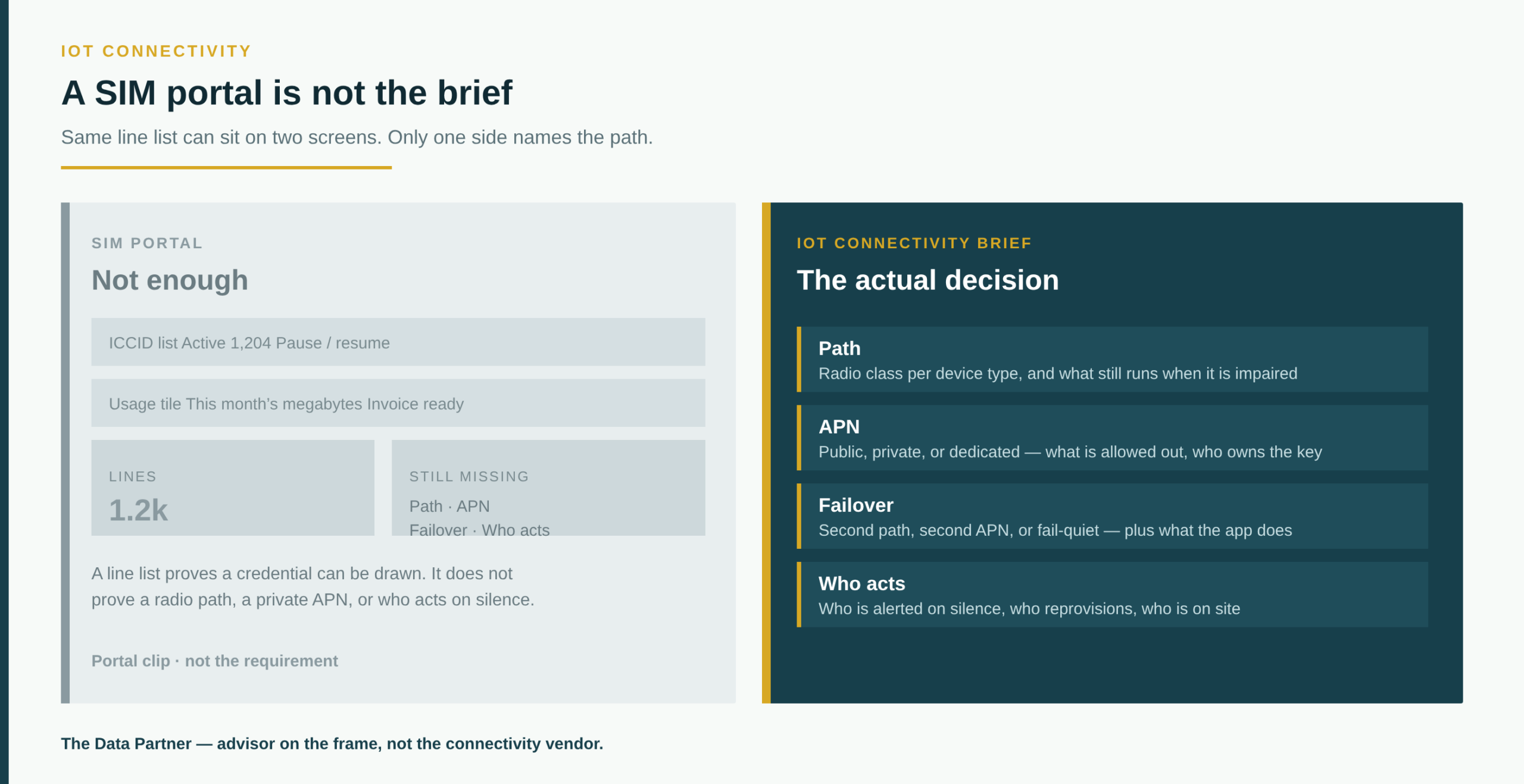
IoT connectivity requirements name the radio path each device class rides, the APN or private network it must use, what happens when that path is impaired, and who acts when a device goes silent. They do not name a usage tile. They do not name a pause button. Two fleets can share the same portal screenshot and still ride different paths, leak into a public APN, leave failover unowned, and have no one who treats a silent device as work.
The usual shortcut collapses connectivity into a portal. Someone logs in, shows SIMs, and treats that screen as the requirement. The path is still “whatever the carrier sold.” The APN is still default. Failover is still a hope that another tower exists. The person who acts when a sensor, a locker, or a kiosk goes dark is still unnamed. You have a SIM list. You do not have IoT connectivity requirements.
That is why the live 5G business connectivity page starts with indoor coverage, independence, and an owner of an impaired morning — for a site path, not a device fleet. This note does not replace that page. It is the fleet-connectivity reminder that sits beside it. When the first job is still the work a site path must carry, use the business internet assessment. Path and class of service for people at desks start on business internet meaning. If the open question is a move, use the office relocation business internet plan — a different job from a silent device.
What IoT connectivity requirements are not
- They are not a SIM portal. A line list proves a credential can be drawn. It does not prove a path, an APN, or who acts.
- They are not a usage tile. Megabytes are a bill input. They are not coverage at the device, and they are not failover.
- They are not a pause button. Stopping a line is a commercial action. It is not a written silent-device procedure.
- They are not 5G business connectivity for a desk. An office radio path is a site class. It is not a fleet APN.
- They are not an office move plan. Relocation writes a cutover. It does not write who acts when a device is silent.
What to write before the portal
- Path: radio class per device type, indoor or outdoor, and what the device must still do when the preferred path is impaired.
- APN and network: public, private, or dedicated; what is allowed out; and who owns the credential.
- Failover: second path, second APN, or a fail-quiet state — plus what the application does when the device cannot speak.
- Who acts: who is alerted on silence, who may reprovision, and who is on site if the radio is not the fault.
- Evidence: a named device that went silent, what was done, and what a later reviewer would accept — not a portal screenshot.
- Remainder: what stays internal after the connectivity invoice — application logic, site power, and the owner of an unrecovered device.
Questions that belong in the first meeting
Ask the incumbent or a challenger to show, not describe:
- Which device classes they treated as in the path, and which they treated as “best effort SIMs.”
- Which APN or private network they require, and what still leaks to a public default.
- What happens when a named device is silent, and who acts without a second meeting.
- What a later reviewer would receive — path, APN, failover, owner — not a SIM portal.
If those answers are a SIM portal and a promised usage week, you do not have IoT connectivity requirements. You have a line list.
What this page is not
This is not a carrier ranking, not an IoT product sheet, and not a claim that The Data Partner already operates anyone’s device fleet after a catalog view. The Data Partner is the advisor on the decision frame, not the connectivity vendor. It is not a reprint of the live 5G path-class page, the live internet assessment, the live meaning page, or the live relocation plan. Skip incentive talk and skip any suggestion that a SIM portal defines IoT connectivity. Write the path, the APN, the failover, and who acts. Then use the live companions, or contact The Data Partner on that packet. Broader buying questions sit on the FAQs page.