
September 17, 2026
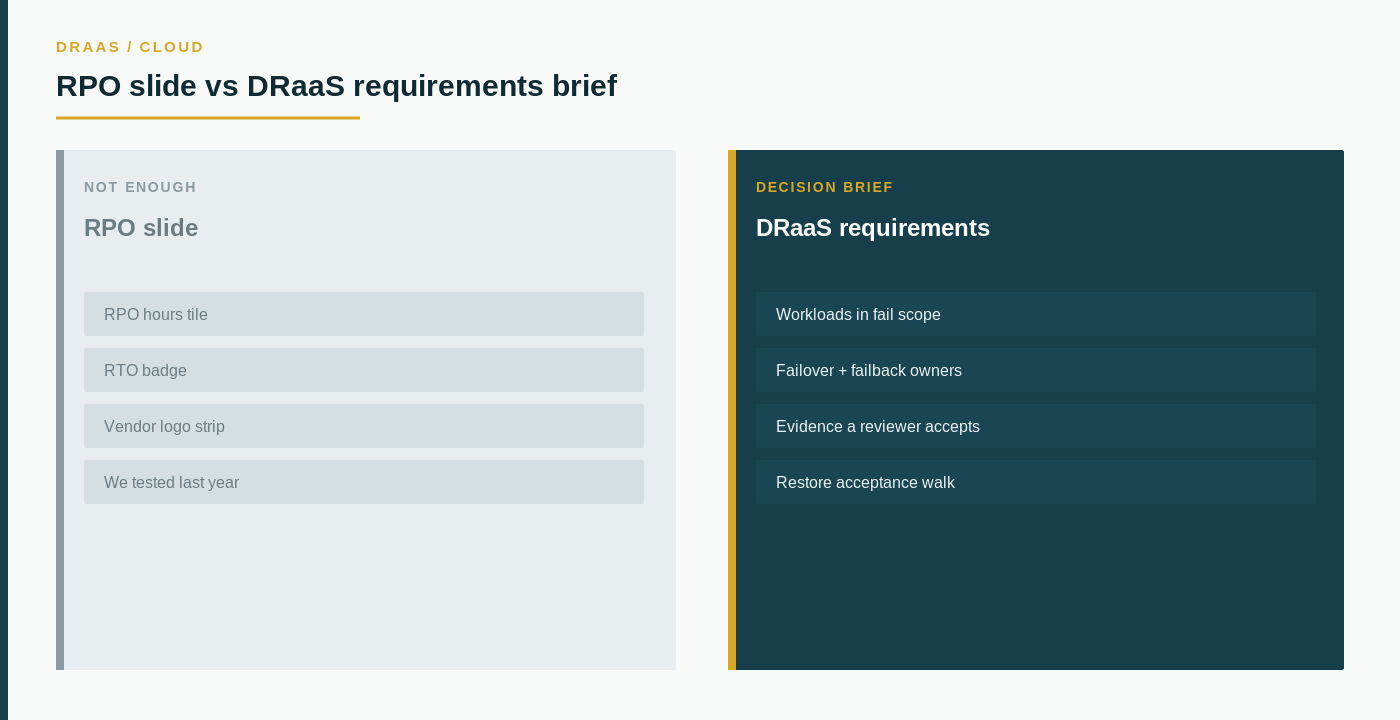
**Concise answer:** An RPO slide is a snapshot — a recovery-point hour, an RTO badge, a logo strip, a date someone claimed a test. A DRaaS requirements brief is an operating decision: which workloads must fail over, who owns failover and failback, what evidence a later reviewer will accept, and what walk proves a restore is accepted. Treat the slide as one input. Do not treat it as the brief.
Disaster decks are good at coloring a tile. They are not designed to tell you whether Mondays payment job still comes back.
The central principle is simple: **an RPO slide is a marketing artifact, while a DRaaS requirements brief is an operating decision.** Those questions are related. They are not interchangeable.
This page is a **DRaaS requirements brief**, not a recovery-time flyer. An RPO hour, a last-year test claim, or a vendor logo can inform the conversation — they do not replace the brief. Do not collapse this note into “A Ticket Volume Chart Is Not MDR Coverage” or “A Cage Quote Is Not a Hybrid Interconnect. Those are detect and colo conversations. This one is about the recover path you are about to buy.
What an RPO slide actually tells you
An RPO slide usually arrives as a one-pager, a QBR appendix, or a “we already meet four hours” claim. It can be useful. It tells you a target someone wrote on a chart.
It does not tell you whether failover, failback, or ownership will survive a real outage.
An RPO slide may represent:
-
A recovery-point hour that never named the workload that must land first.
-
An RTO badge that assumes the same network path as the drawing.
-
A logo strip that does not say who runs the runbook after hours.
-
A test date that expired when the application changed.
-
A “we tested last year” line with no evidence a reviewer can open.
A tile is not a fail scope. A badge is not a failback owner. The useful question is not “How green is the RPO?” It is “Which workloads, owners, evidence, and acceptance rows must be true before we treat this as a DRaaS requirement, and what proof would we accept?”
The [disaster recovery as a service requirements](https://thedatapartner.com/disaster-recovery-as-a-service-requirements/) page is the right place to reset the recovery decision before you argue about a slide hour.
Separate the slide from the DRaaS brief
An RPO slide does not show whether the recover path is operable.
Important questions remain open even when the tile looks green:
-
Which workloads are in fail scope, and which are known-unknown?
-
What order applications must return, not only a single RPO number?
-
Who owns failover, failback, and the after-hours act?
-
What network, identity, and data path must be true when the site is dark?
-
How a failed restore is noticed, and who walks the job after hours?
-
What evidence means accepted — a slide, a ticket, or a named application restore?
A slide cannot answer these questions because it is not designed to capture them.
Compare the slide with the requirements brief
| Decision area | What an RPO slide may show | What the DRaaS requirements brief must document |
|—|—|—|
| **Decision identity** | A recovery-time tile | Whether this is a new buy, a re-test, or a failed-site fix |
| **Fail scope** | One RPO hour | Workloads in scope, order of return, and known exclusions |
| **Owners** | Sometimes a vendor name | Failover and failback owners timed for after hours |
| **Path** | Assumed connectivity | Network, identity, and data path that must be true when dark |
| **Evidence** | “Tested last year” | Artifacts a later reviewer can open without a sales call |
| **Acceptance** | Slide date | Who walks the real restore, and what evidence they sign |
Two slides can show the same four-hour RPO and still describe different recovers. One may have restored the payment job at load. The other may have restored a lab VM.
Write the brief before you treat the slide as done
Start with the work, not the recovery-time badge.
Write one record for DRaaS requirements:
-
Decision identity: new buy, re-test, or failed-site fix; why now; who owns the outcome.
-
Fail scope and return order a operator would recognize, not a legend.
-
Failover and failback owners, including after-hours act.
-
Path assumptions that must be true on day one — network, identity, data.
-
Acceptance: the restore walk that proves the application, not only the slide.
The [backup as a service](https://thedatapartner.com/backup-as-a-service/) page is the companion when the open question is still copy and retention, not failback. The [cloud assessment](https://thedatapartner.com/cloud-assessment/) and [cloud provider evaluation](https://thedatapartner.com/cloud-provider-evaluation/) pages are companions when the recover path also has to choose where the workloads land.
Questions that belong in the first meeting
Ask the incumbent or a challenger to show, not describe:
-
Which workloads they treated as in scope, and which they treated as “the RPO already proves it.”
-
A failback owner timed for after hours, not a logo strip.
-
Evidence a later reviewer would receive as requirements proof — not an RPO slide and a promised recovery week.
-
What a failed restore looks like on the first Monday after cutover.
If those answers are an RPO slide and a last-year test claim, you do not have a DRaaS requirements brief. You have a slide.
What this page is not
This is not a recovery-time ranking, not a DRaaS product sheet, and not a claim that The Data Partner already recovered anyones estate after a catalog view. Skip incentive talk and skip any suggestion that an RPO tile defines a brief. Write fail scope, owners, evidence, and acceptance for the recover path you are buying. Then use the live companions, or [contact](https://thedatapartner.com/contact/) The Data Partner on that packet. Broader buying questions sit on the [FAQs](https://thedatapartner.com/faqs/) page.