

September 12, 2026
Concise answer: A ticket volume chart is an operations still — open tickets, a mean-time tile, an auto-close percentage, a queue screenshot. MDR coverage is an operating decision: what is actually in detect scope, who may contain and how fast, who acts after hours, and what evidence a later reviewer would accept. Treat the chart as one input. Do not treat it as coverage.
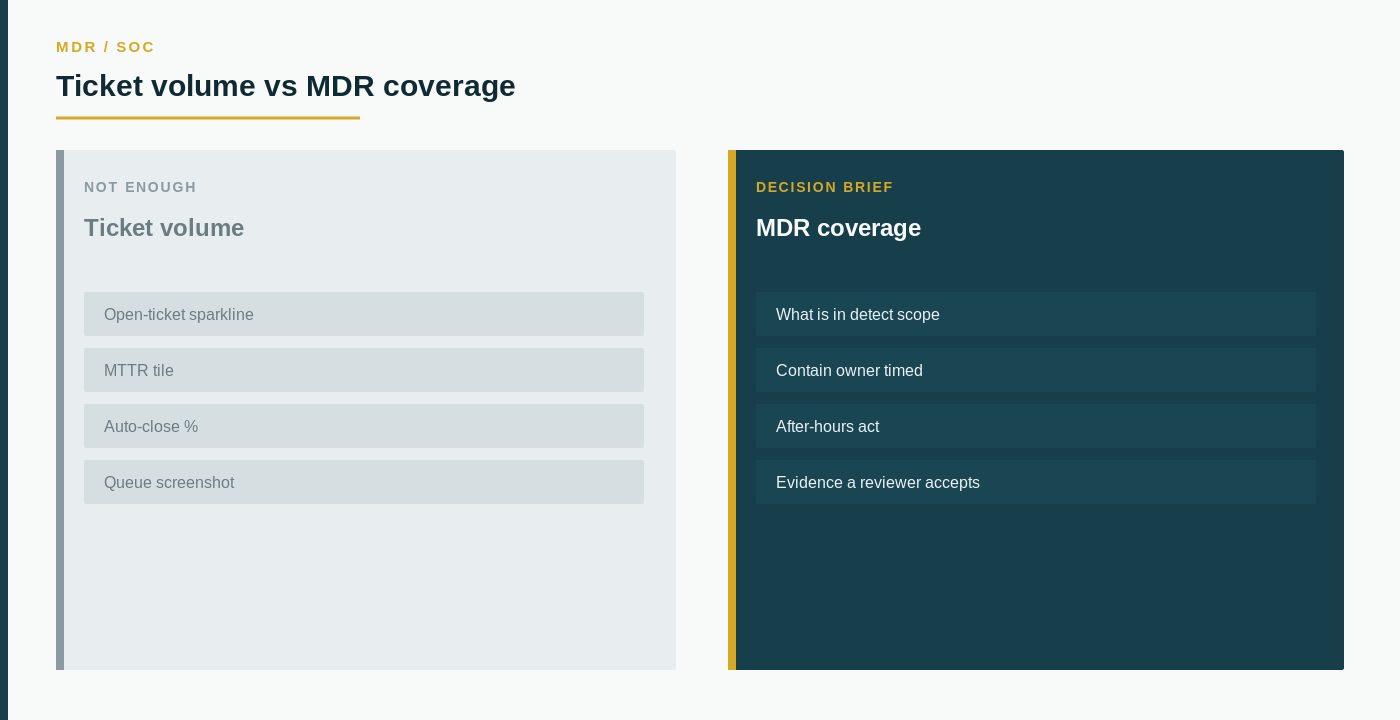
SOC queues are good at showing height. They are not designed to tell you whether the next alert still matches the work.
The central principle is simple: ticket volume is a queue artifact, while MDR coverage is an operating decision. Those questions are related. They are not interchangeable.
This page is an MDR coverage brief, not a SOC staffing poster. An alert inbox, a forwarded syslog, or a mean-time tile can inform the conversation — they do not replace coverage. Do not collapse this note into “An Alert Inbox Is Not a SOC,” “An Alert Feed Is Not an MDR Brief,” or “Alert Forwarding Is Not an MSSP vs. MDR Decision.” Those are category and feed conversations. This one is about whether coverage is true when the chart looks busy.
What a ticket volume chart actually tells you
A ticket volume chart usually arrives as a monthly QBR slide, a sparkline in a portal, or a “we closed 12,000 tickets” boast. It can be useful. It tells you how tall the queue was.
It does not tell you whether detect, contain, or after-hours action happened for the work you care about.
A ticket volume chart may represent:
- Noise that was opened and auto-closed without a human judgment.
- A mean-time tile that starts when someone finally accepted the ticket.
- A queue that mixes phishing mailbox work with a ransomware contain.
- A staffing proof that never names what is out of detect scope.
- A month that looked busy because a noisy source was never tuned.
A sparkline is not a scope statement. A close rate is not a contain owner. The useful question is not “How many tickets did we work?” It is “Which assets and identities are in detect scope, who may contain after hours, and what evidence would a reviewer accept?”
The managed detection and response requirements page is the right place to reset the MDR brief before you argue about queue height.
Separate the chart from the coverage brief
A ticket volume chart does not show whether MDR coverage is operable.
Important questions remain open even when the sparkline looks industrious:
- Which endpoints, identities, and cloud accounts are in detect scope, and which are known-unknown?
- What “contain” means in minutes — isolate, disable, or only page?
- Who acts after hours, and what they are allowed to do without waiting for a customer ticket?
- How a false-positive is judged, and who can stop a noisy source?
- What a later reviewer would receive — a case file, or a volume chart?
A queue cannot answer these questions because it is not designed to capture them.
Compare the chart with the coverage brief
| Decision area | What a ticket volume chart may show | What MDR coverage must document |
|---|---|---|
| Decision identity | How busy the queue was | Whether this is detect-only, contain, or a full response retain |
| Scope | Ticket sources | Endpoints, identities, cloud, and what is explicitly out |
| Contain | Sometimes an MTTR tile | Who may isolate or disable, and the clock that starts |
| After hours | A 24/7 badge | Named actor, authority, and what they leave behind |
| Evidence | Close counts | Case file a reviewer would accept, not a sparkline |
| Tuning | Auto-close % | Who may quiet a noisy source, and when |
Two charts can show the same volume and still describe different coverage. One may include contain with a timed owner. The other may be a mailbox that never leaves the queue.
Write coverage before you treat the chart as proof
Start with scope, not the sparkline.
Write one record for MDR coverage:
- Decision identity: detect, contain, or response retain; why now; who owns the outcome.
- Scope a later reviewer would recognize, including known-unknowns.
- Contain authority and the clock, including after hours.
- Evidence: the case file, not the monthly volume tile.
- Remainder the customer still owns after the MDR invoice.
The SOC as a service page is the companion when the open question is still a watch floor versus a contain service. MSSP vs MDR is the companion when the category is still unseparated. Managed cybersecurity provider evaluation is the companion when you are ready to score the operated stack.
Questions that belong in the first meeting
Ask the incumbent or a challenger to show, not describe:
- Which assets they treated as in detect scope, and which they treated as “the ticket volume already proves coverage.”
- A contain that happened after hours, including who acted and what evidence remains.
- A noisy source they tuned, and who was allowed to stop it.
- What a later reviewer would receive as coverage proof — not a ticket volume chart and a promised SOC quarter.
If those answers are a ticket volume chart and a 24/7 badge, you do not have MDR coverage. You have a queue.
What this page is not
This is not an MDR ranking, not a SOC product sheet, and not a claim that The Data Partner already contains anyone’s estate after a catalog view. Skip incentive talk and skip any suggestion that a volume chart defines coverage. Write scope, contain, after-hours act, and evidence for the work you are buying. Then use the live companions, or contact The Data Partner on that packet. Broader buying questions sit on the FAQs page.