
A conversation that starts with an alert inbox — “tickets already land here,” “the SOC forwards everything,” “we have a mailbox for after hours” — usually fails at the first detection no one may contain, the first weekend with no actor, or the first review that finds no case packet, not at the first unread message. An alert inbox is a mailbox. It is not SOC as a service.
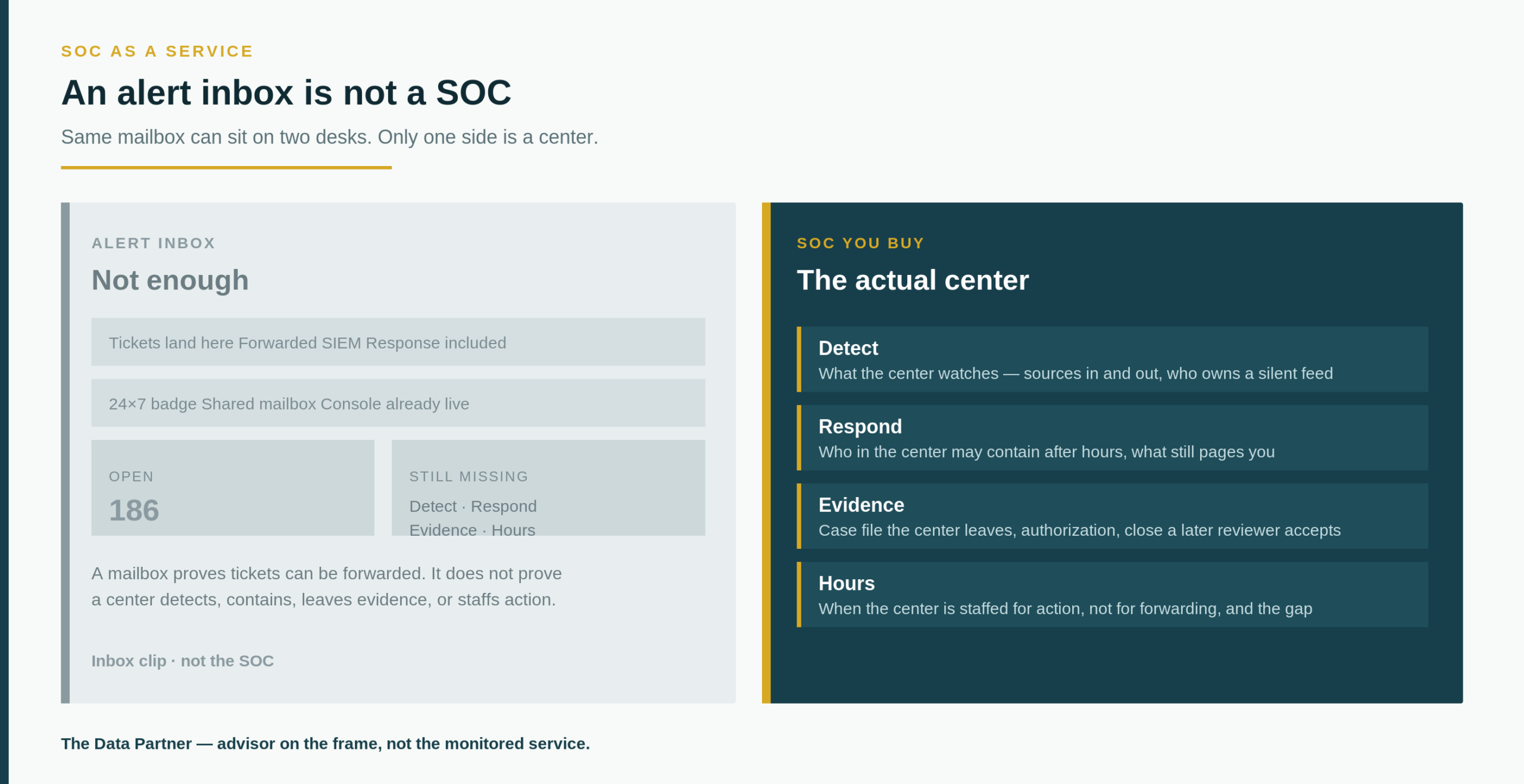
SOC as a service is the operated center you buy: what is detected, who may respond, what evidence a later reviewer would accept, and which hours are actually staffed for action. It does not name a mailbox. It does not name a forwarding rule. Two buyers can share the same inbox and still watch different telemetry, leave containment unauthorized, staff watch-only hours, and have nothing that proves a case was completed.
The usual shortcut collapses a SOC into an inbox. Someone opens the mailbox, shows a folder of forwarded tickets, and treats that folder as the center. Telemetry is still unread. Response is still “we will email you.” Evidence is still a message that closed itself. Hours are still a badge on a slide. You have an alert inbox. You do not have SOC as a service.
That is why the live MSSP versus MDR page starts with scope, telemetry, investigation, and response authority rather than a product family. This note does not replace that page. It is the SOC-as-a-service reminder that sits beside the comparison: an inbox is not the center. When the next job is detection-and-response depth, use managed detection and response requirements after the detect, respond, evidence, and hours rows are written for the center, not instead of them. When the next job is which names belong on a list, use MSSP providers. If the first job is still what the work is, use managed cybersecurity meaning. If the open question is still who acts after hours, use co-managed versus fully managed security before anyone treats a mailbox as the operating model.
What SOC as a service is not
- It is not an alert inbox. A mailbox proves tickets can be forwarded. It does not prove a center detects, responds, or leaves evidence.
- It is not a 24×7 badge. A hours logo is not a named actor in the center who may contain at 02:00.
- It is not an MDR brief. Detection-and-response depth is the sibling page’s job. It is not proof you bought a SOC.
- It is not an MSSP definition. A provider category is meaning work. It is not the operated center on this page.
- It is not a shared mailbox. Forwarding is a distribution list. That operating-model question lives on the co-managed page.
What to write before the inbox
- Detect: what the center watches, sources in and out, and who owns health when a feed goes silent.
- Respond: preauthorized containment, what still pages the customer, and who in the center may isolate a host or disable an account after hours.
- Evidence: the case file the center leaves, the telemetry pointer, the authorization, and the close a later reviewer would accept — not an inbox screenshot.
- Hours: when the center is staffed for action, not for forwarding, and what happens in the gap.
- Remainder: what the internal team still patches, restores, and accepts after the SOC invoice.
Questions that belong in the first meeting
Ask the incumbent or a challenger to show, not describe:
- Which telemetry the center will not bid without, and how they prove those sources stay healthy.
- A redacted case from detection through containment, including the customer approval and the failed-handoff path.
- What “response” includes in writing — recommend, coordinate, or preauthorized contain — and who owns recovery after.
- What evidence the center leaves, and which hours are actually staffed for action, not for watching an inbox.
If those answers are an alert inbox and a promised SOC week, you do not have SOC as a service. You have a mailbox.
What this page is not
This is not a platform ranking, not a SOC product sheet, and not a claim that The Data Partner already operates anyone’s center after a catalog view. The Data Partner is the advisor on the decision frame, not the monitored service. It is not a reprint of the live MSSP-versus-MDR comparison, the live MDR-requirements brief, the live shortlist, the live meaning page, or the live operating-model brief. It is not an MDR brief and not an MSSP definition. Skip incentive talk and skip any suggestion that an alert inbox defines a SOC. Write detect, respond, evidence, and hours for the center you are buying. Then use the live companions, or contact The Data Partner on that packet. Broader buying questions sit on the FAQs page.