
A conversation that starts with a policy slide — “never trust, always verify,” “we already bought ZTNA,” “the framework is on the wall” — usually fails at the first unowned identity, the first exception no one can revoke, or the first path that still trusts the subnet, not at the first badge. A policy slide is a slogan. It is not a zero trust planning checklist.
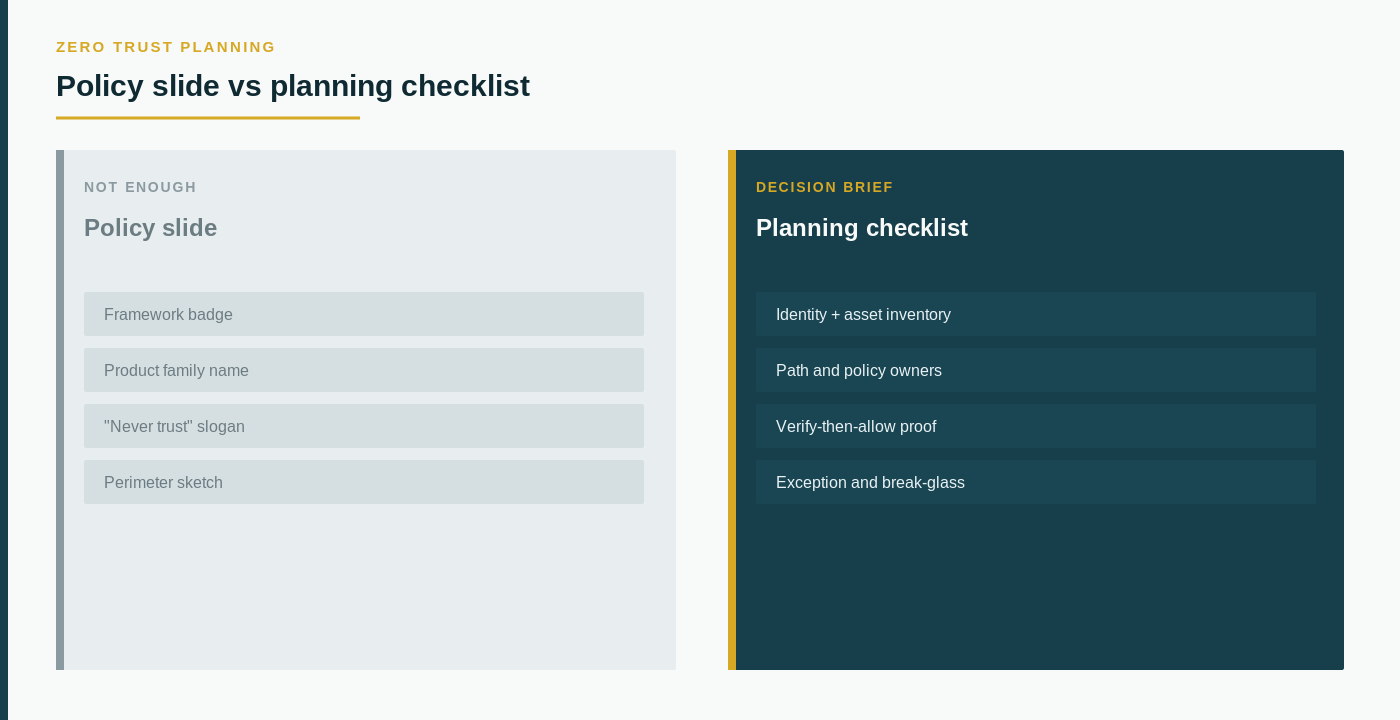
A zero trust planning checklist names which identities and assets are in scope, which paths are verified before they are allowed, who owns an exception, and what evidence a later reviewer would accept. It does not name a framework badge. It does not name a product family. Two buyers can share the same slide and still leave service accounts unread, treat the subnet as trusted, and have no one who may revoke access after hours.
The usual shortcut collapses the plan into a poster. Someone opens a “never trust” deck, circles a product family, and treats that purchase as the plan. Identities were never inventoried. Paths are still “the VPN already does it.” Exceptions are still a shared admin. Evidence is still a screenshot. You have a policy slide. You do not have a zero trust planning checklist.
That is why the live managed cybersecurity meaning page starts with what is operated rather than a product family. This note does not replace that page. It is the zero-trust planning reminder that sits beside it: a slogan is not the checklist. When the next job is still scoring the operated stack, use managed cybersecurity provider evaluation after the inventory, path, exception, and evidence rows are written, not instead of them. If the argument is still “the provider secures the cloud,” use the cloud security responsibility matrix — that is identities, keys, and logs, not a framework badge. When the open question is still who acts after hours, use co-managed versus fully managed security. If the next job is which names belong on a list, use MSSP providers.
What a zero trust planning checklist is not
- It is not a policy slide. A slogan proves a deck can be printed. It does not prove inventory, owners, or revoke.
- It is not a product family. A ZTNA SKU is a path class. It is not the plan for identities and exceptions.
- It is not a managed-cyber scored list. That sibling scores the operated stack. It is not the planning rows on this page.
- It is not a shared-responsibility cartoon. Identities and keys are the matrix page’s job. They are not a verify-then-allow proof.
- It is not an MSSP definition. A provider category is meaning work. It is not the exception you can revoke after hours.
What to write before the slide
- Inventory: identities, service accounts, devices, and apps that must be verified — not “users already have MFA.”
- Paths: which hops are verified before they are allowed, and which subnets are still trusted by habit.
- Owners: who may grant, who may revoke, and who is paged when an exception is still open after hours.
- Exceptions: what break-glass exists, how long it lives, and what evidence remains when it is used.
- Remainder: what the internal team still owns after the product invoice — logs, identity source, and residual trust.
Questions that belong in the first meeting
Ask the incumbent or a challenger to show, not describe:
- Which identities and assets they treated as in scope, and which they treated as “the slide already covers never trust.”
- A path that is verified before it is allowed, and a path that still trusts the subnet.
- Who may revoke an exception after hours, and what they leave behind.
- What a later reviewer would receive as planning proof — not a policy slide and a promised zero-trust quarter.
If those answers are a policy slide and a promised framework week, you do not have a zero trust planning checklist. You have a slogan.
What this page is not
This is not a platform ranking, not a ZTNA product sheet, and not a claim that The Data Partner already operates anyone’s identity fabric after a catalog view. The Data Partner is the advisor on the decision frame, not the security operator. It is not a reprint of the live managed-cyber meaning page, the live provider evaluation, the live cloud security matrix, or the live co-managed versus fully managed note. Skip incentive talk and skip any suggestion that a policy slide defines a plan. Write inventory, paths, owners, and exceptions for the work you are buying. Then use the live companions, or contact The Data Partner on that packet. Broader buying questions sit on the FAQs page.