
September 12, 2026
Concise answer: A HIPAA attestation is a statement that someone asserts certain safeguards exist, often as a questionnaire, a letter, or a signed checklist. A healthcare cybersecurity provider evaluation is an operating decision: which security domains are in scope for this environment, who owns detection and response, what evidence you will accept, and how you will score incumbents and challengers the same way. Treat the attestation as one input. Do not treat it as the evaluation.
Attestations are optimized to be signed. Evaluations are optimized to be compared when two providers describe the same control in different language.
The central principle is simple: an attestation is a claim, while a healthcare cyber provider evaluation is a scored operating decision. Those questions are related. They are not interchangeable.
This page is not an assessment-inventory primer. A related live note explains why a HIPAA fact sheet is not a cybersecurity assessment inventory. That page is about what you write down before you shop. This page is about how you evaluate a provider after the shopping question is already “who operates which parts of the security program.” Do not copy one into the other.
What a HIPAA attestation actually tells you
A HIPAA attestation usually arrives as a BA questionnaire, a “we encrypt” letter, or a packet of policies. It can be useful. It tells you that a provider is willing to make a written claim about safeguards.
It does not tell you whether that provider can operate the domains you need, with evidence you can reuse at audit time.
An attestation line may represent:
- A policy PDF with a recent date.
- A control that exists in a different customer environment than yours.
- A shared-responsibility statement that still leaves detection, identity, or backup unowned.
- Encryption or access language that does not name the systems in your environment.
- A signature from a person who will not be on the incident bridge.
A signature is not coverage. A questionnaire score is not an operating model. The useful question is not “Did they attest?” It is “Which security domains must this provider own for this healthcare environment, what evidence will we accept, and how will we score every option the same way?”
The managed cybersecurity meaning page is the right place to reset the category before you argue about letters.
Separate the attestation from the provider evaluation
A HIPAA attestation does not show whether the provider can be compared fairly against an incumbent.
Important questions remain open even when the packet looks complete:
- Which domains are in scope: identity, endpoints, email and collaboration, data and backup, detection and response, third parties, and governance?
- Who is the named owner for each domain after hours, not only during onboarding?
- What is the evidence standard (restore test, access review, detection drill) versus a policy assertion?
- How is regulated information kept out of unmanaged tools, without collecting that information in the evaluation itself?
- What happens during an incident: who declares, who communicates, who preserves evidence?
- Which responsibilities remain with the healthcare organization no matter who is hired?
- How will you score an incumbent “we already attest” packet against a challenger’s operating model without mixing apples?
An attestation packet cannot answer these questions because it is not designed as a scorecard.
### Compare the attestation with the evaluation brief
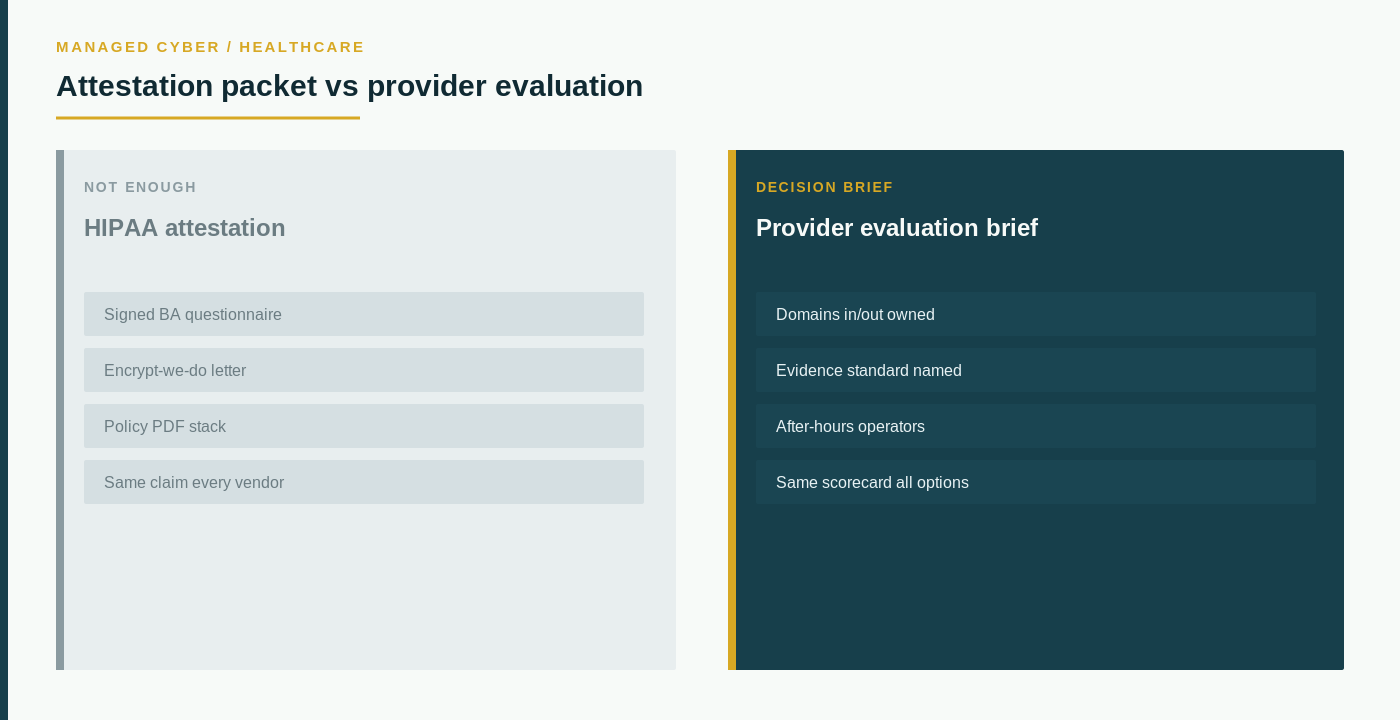
| Decision area | What a HIPAA attestation may show | What the provider evaluation must document | |—|—|—| | Decision identity | A signed claim about safeguards | Whether you are replacing, augmenting, or re-scoping a managed security provider | | Domain coverage | Control names on a form | Which domains are in, which are out, and who owns each | | Evidence | Policies, letters, checkboxes | Restore tests, detection drills, access reviews, and named artifacts — not PHI | | Operating model | “We are HIPAA aligned” | Hours, escalation, incident roles, and what remains with the organization | | Comparison | One packet | The same scoring frame for incumbent and challenger | | Timing | A questionnaire due date | Audit windows, contract notice, and a decision date earlier than the commercial deadline |
Two providers can both “attest” and still be incomparable. One may operate detection and response. The other may only forward alerts. The letter will not make that distinction unless you write it into the evaluation.
Inventory evaluation criteria before you collect another letter
Start with the provider scorecard, not the attestation inbox.
This is a provider evaluation for healthcare environments. It is not a substitute for writing an assessment inventory of your own domains. If the inventory does not exist yet, stop and write owners and domains first. If the inventory exists and the question is who should operate which parts, continue here.
Write one record for the evaluation:
- Decision identity: replace, augment, or re-scope; why now; who owns the outcome.
- Domains in scope and the internal owner who will accept or reject a provider’s claim for each.
- Evidence you will accept (and will not accept): a dated restore test versus a policy PDF; a detection drill versus a logo slide.
- Shared responsibility: what must remain inside the healthcare organization.
- Constraints: change windows, systems that cannot stop, approval paths, and information that requires a controlled exchange.
- Scoring: required capabilities versus preferences, applied to every option.
Do not collect protected health information, credentials, network diagrams with secrets, incident records, or patient-level anything in this evaluation. This is not legal advice. An attestation is not a legal opinion, not a substitute for counsel, and not proof that a given organization is in or out of a particular regulatory scope. Watch your own counsel and the relevant regulators for obligations that apply to you.
The managed cybersecurity provider evaluation page is the companion scorecard. The MSSP providers overview belongs after the scorecard exists, not as a substitute for it.
Questions that belong in the first provider meeting
Ask the incumbent — and any challenger — to show, not describe:
- Which evaluation domains they believe they own, and the named operator for each after hours.
- What evidence they would produce tomorrow for access control, backup restore, and detection — without receiving PHI in the demo.
- How they keep regulated working files out of unmanaged tools, as an operating practice, not as a slogan.
- How they want to be scored against an incumbent attestation packet so the letter is not compared to an operating model.
- What remains your responsibility if you sign.
If those answers are a signed HIPAA letter and a promised “readiness week,” you do not have a healthcare cyber provider evaluation. You have an attestation.
What this page is not
This page is not legal advice, not a HIPAA implementation guide, and not an assessment inventory. It does not tell you how to handle protected health information. It does not interpret a Security Rule text. It does not name security vendors. It does not treat a signature as coverage, and it does not claim that any organization already completed this evaluation.
If you still need the inventory framing, use the live HIPAA fact sheet is not a cybersecurity assessment inventory note, then return here for provider scoring. Use managed cybersecurity meaning to keep the category straight, write the scorecard on the provider evaluation page, then request the next conversation. If you need a structured intake after the brief exists, use contact. Related buying questions also sit on FAQs.