

September 12, 2026
Concise answer: A discount line is a commercial concession — a percentage off list, a credit, a bundled SKU, or a “use it or lose it” incentive tied to a renewal date. A cloud contract renewal checklist is an operating decision: which services and accounts are actually in the contract, which terms lock you in, who owns spend and incident response after the term starts, and what evidence you will use before you extend, reallocate, or exit. Treat the discount as one input. Do not treat it as the checklist.
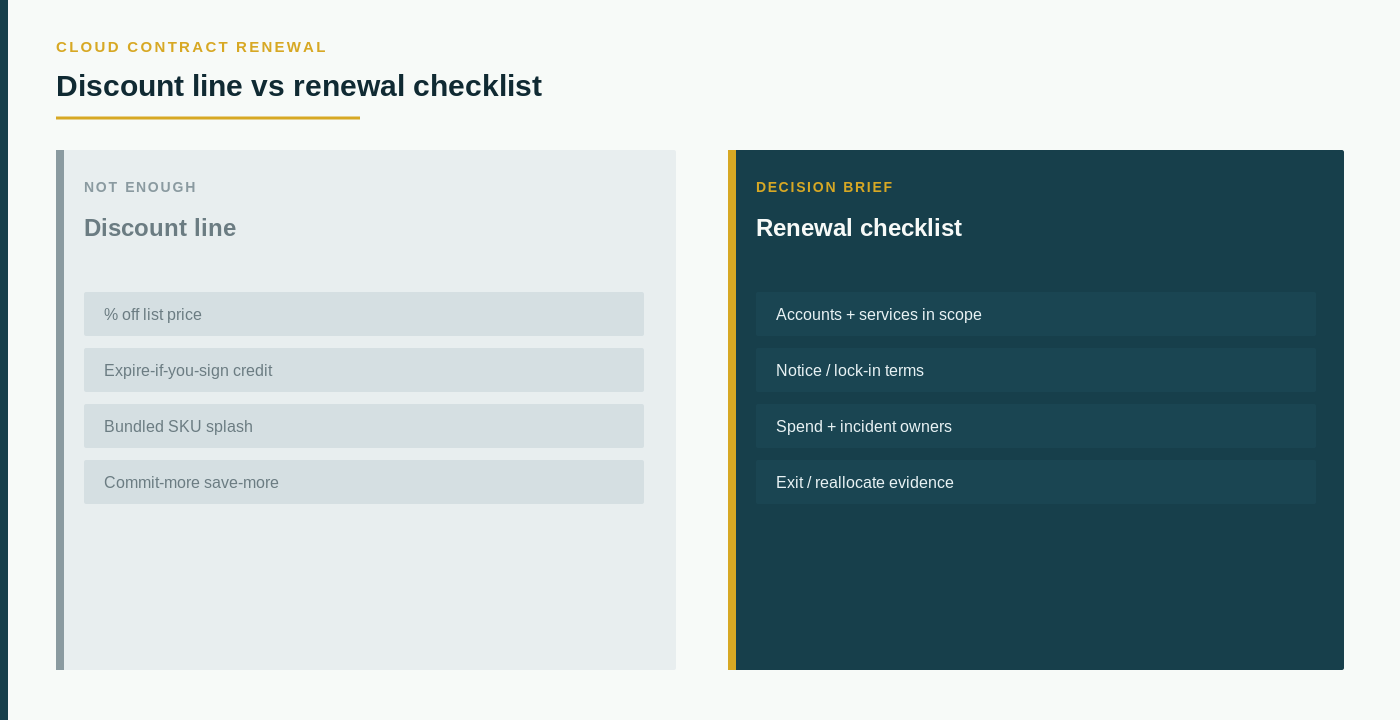
Renewal desks are good at pricing the next term. They are not designed to tell you whether the next term still matches the work.
The central principle is simple: a discount is a commercial input, while cloud contract renewal is an operating decision. Those questions are related. They are not interchangeable.
This page is a contract renewal checklist, not a cost baseline. A usage invoice, a reserved-capacity discount, or a token bill can inform spend — they do not replace the contract review. Do not collapse this note into “A Reserved-Instance Discount Is Not a Cloud Cost Baseline” or “A Token Invoice Is Not a Cloud Cost Baseline.” Those are baseline conversations. This one is about the term you are about to sign.
What a discount line actually tells you
A discount line usually arrives as a renewal quote, a “commit more, save more” table, or a credit that expires if you do not sign. It can be useful. It tells you a proposed price for a proposed commit.
It does not tell you whether the commit matches the accounts, services, and operating model you will live with.
A discount line may represent:
- A percentage off a list you never pay.
- A commit that assumes growth you have not evidenced.
- Credits that apply only to a subset of services or regions.
- A bundled SKU that hides support, egress, or a product you do not use.
- A shorter notice window in exchange for a better rate.
- A true-up or overage path that is more expensive than the headline rate.
A percentage is not a service inventory. A commit is not an exit plan. The useful question is not “How large is the discount?” It is “Which contract terms, services, and operating owners must be true before we extend this term, and what evidence would we accept?”
The cloud assessment page is the right place to reset the decision before you argue about the rate.
Separate the discount from the renewal checklist
A discount line does not show whether the next term is operable.
Important questions remain open even when the percentage looks attractive:
- Which accounts, subscriptions, and projects are in the contract, and which sit outside it?
- Which services are committed versus consumed on demand, and who can change that mix?
- What are notice dates, auto-renew mechanics, and customer responsibilities at term end?
- Who owns identity, backup, incident response, and spend review on day one of the next term?
- Which data-residency, retention, and support-hour terms actually apply to your workloads?
- What happens on overage, unused commit, or a service you planned to retire?
- How will you compare the incumbent renewal to an alternative without mixing a discount slide with an operating model?
A quote cannot answer these questions because it is not designed to capture them.
### Compare the discount with the renewal checklist
| Decision area | What a discount line may show | What the contract renewal checklist must document | |—|—|—| | Decision identity | A rate and a term | Whether this is an extension, a reallocation, a reduction, or an exit | | Service inventory | SKUs and a commit number | Accounts, services in use, services unused, and services planned to retire | | Commercial mechanics | Percentage, credits, true-up | Notice, auto-renew, overage, unused-commit treatment, and customer duties | | Operating ownership | Sometimes a support SKU | Who reviews spend, who handles incidents, who can turn a service off | | FinOps inputs | A cheaper unit price | Attribution, showback or chargeback owners, and the first-invoice review | | Timing | Quote expiry | Decision date earlier than notice; testing and exit work if you do not sign |
Two quotes can show the same discount and still describe different contracts. One may protect price on the services you actually run. The other may concentrate savings on a commit you will not consume.
Inventory the contract before you accept the rate
Start with the term, not the percentage.
Write one record for the renewal:
- Decision identity: extend, re-scope, reduce, or exit; why now; who owns the outcome.
- Inventory: accounts and services in the contract, owners who can validate usage, and items that should not be recommitted.
- Commercial mechanics: notice, auto-renew, overage, unused commit, data-export and exit assistance.
- Operating model: spend review, incident path, identity and backup owners after the term starts.
- FinOps inputs: how the first invoices will be checked against the commit — as a control, not as a substitute for the contract review. The cloud FinOps readiness page belongs here as a supporting discipline, not as the whole decision.
- Comparison criteria: the same evidence fields for incumbent renewal and any alternative.
Do not put credentials, invoice dumps with account secrets, or customer data into the first checklist. Capture owners, contract clause names, and the evidence you will request later.
The cloud provider evaluation page belongs after the checklist exists, not as a way to skip it.
Questions that belong in the first renewal meeting
Ask the incumbent commercial team — and any challenger — to show, not describe:
- Which services in the proposed commit were used in the last term, and which were not.
- The notice, auto-renew, and unused-commit clauses in writing, not as a verbal “we will be flexible.”
- Who will review the first invoices against the commit, and what happens if usage and commit diverge.
- What exit assistance, data-export, and remaining-term obligations look like if you do not sign.
- How they want the discount to be scored so a percentage is not compared to a different operating model.
If those answers are a discount table and a promised “we will true up later,” you do not have a cloud contract renewal checklist. You have a discount line.
What this page is not
This page is not a cost baseline, not a reserved-capacity shopping list, and not a token or usage-invoice explainer. It is not a provider bake-off and not a claim that any environment already completed this review. It does not name cloud suppliers. It does not treat a cheaper unit price as proof that the next term is operable, attributable, or exit-ready.
Use the cloud assessment to keep the decision frame, add FinOps controls from cloud FinOps readiness, write the term and owners, then request the next conversation. If you need a structured intake after the brief exists, use contact. Related buying questions also sit on FAQs.