
September 18, 2026
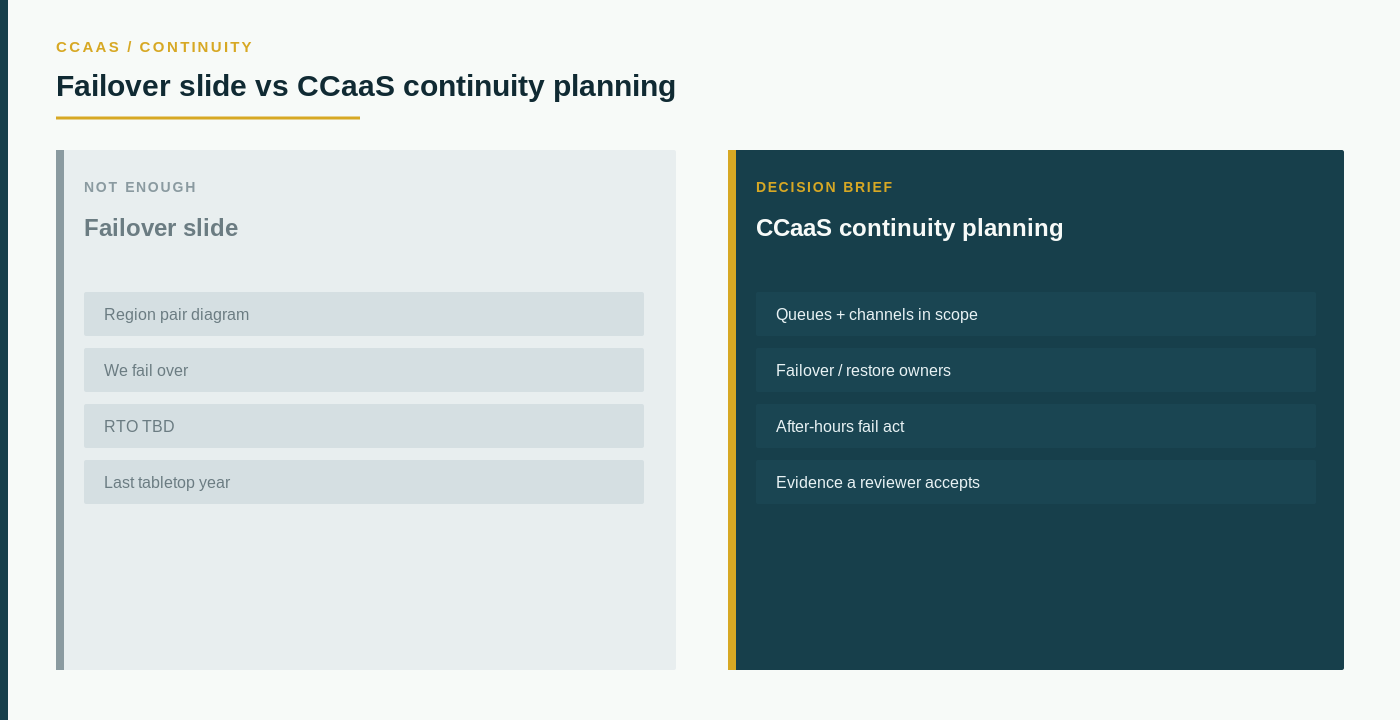
Concise answer: A failover slide is a snapshot — a region-pair diagram, a “we fail over” claim, an RTO left TBD, a last-tabletop year. CCaaS business continuity planning is an operating decision: which queues and channels are in scope, who owns failover and restore, what evidence a later reviewer will accept, and how a failed failover is noticed after hours. Treat the slide as one input. Do not treat it as the plan.
Architecture teams are good at drawing region pairs. They are not designed to tell you whether Monday’s queue path still works when a channel was wrong.
The central principle is simple: a failover slide is a diagram artifact, while CCaaS continuity planning is an operating decision. Those questions are related. They are not interchangeable.
This page is a CCaaS business continuity planning brief, not a region flyer. A failover diagram, an RTO placeholder, or a tabletop timestamp can inform the conversation — they do not replace the plan.
Integration and recovery are separate conversations. This one is about the contact-center continuity path you are about to keep or replace.
What a failover slide actually tells you
A failover slide usually arrives as a deck appendix, a QBR diagram, or a “we have dual regions claim. It can be useful. It tells you that someone drew a pair at a moment.
It does not tell you whether queue ownership, restore acts, or after-hours failed-failover paths will survive a real outage.
A failover slide may represent:
-
A region-pair diagram that never named which queues and channels are in continuity scope.
-
A “we fail over” claim that ignores IVR, CRM handoff, and recording paths.
-
An RTO left TBD with no failover or restore owner timed for after hours.
-
A last-tabletop year that expired when the platform and carrier mix changed.
-
A slide that assumes the same agent and network posture as the drawing.
A slide is not continuity scope. A region pair is not a restore owner. The useful question is not “Do we have two regions?” It is Which queues, channels, failover owners, restore acts, and evidence rows must be true before we treat this as CCaaS continuity planning, and what proof would we accept?
The CCaaS meaning page is the right place to reset what contact-center-as-a-service covers before you argue about a slide.
Separate the slide from continuity planning
A failover slide does not show whether the continuity program is operable.
Important questions remain open even when the slide looks complete:
-
Which queues and channels are in scope, and which are known exceptions?
-
Who owns failover, restore, and communicate — including after hours?
-
What happens when IVR fails, CRM handoff drops, or recording stops mid-event?
-
How a failed failover is noticed, and who walks the act after hours?
-
What evidence means accepted a diagram, a ticket, or a named failover walk?
-
Whether platform and readiness claims match the path agents actually take.
A slide cannot answer these questions because it is not designed to capture them.
Compare the slide with CCaaS continuity planning
| Decision area | What a failover slide may show | What CCaaS continuity planning must document |
|---|---|---|
| Decision identity | A region-pair diagram | Whether this is a new plan, a re-eval, or a failed-failover fix |
| Scope | “We fail over | Queues, channels, and known exceptions in continuity scope |
| Owners | RTO TBD | Failover, restore, and communicate owners timed for after hours |
| Path | Assumed dual region | Real IVR, CRM, recording, and carrier path for the queues that matter |
| Evidence | Last tabletop year | Artifacts a later reviewer can open without a sales call |
| Acceptance | Diagram present | Who walks a failover drill, and what evidence they sign |
Two slides can show the same region pair and still describe different continuity programs. One may have restored queues at load. The other may have refreshed a logo.
Write the plan before you treat the slide as done
Start with the work, not the diagram.
Write one record for CCaaS business continuity planning:
-
Decision identity: new plan, re-eval, or failed-failover fix; why now; who owns the outcome.
-
Scope of queues and channels an operator would recognize, not a legend.
-
Failover, restore, and communicate owners, including after-hours act.
-
Path assumptions that must be true on day one — IVR, CRM, recording, carrier, agent path.
-
Acceptance: the failover or restore walk that proves the path, not only the slide.
The compare CCaaS platforms page is the companion when the open question is still which platform path you are keeping or replacing. The CCaaS implementation readiness checklist page is the companion when continuity sits next to a go-live readiness review. The contact center quality management requirements page is a companion when continuity has to survive a QA and coaching path review.
Questions that belong in the first meeting
Ask the incumbent or a challenger to show, not describe:
-
Which queues and channels they treated as in scope, and which they treated as “the failover slide already proves it.”
-
A failover and restore owner timed for after hours, not an RTO TBD cell.
-
Evidence a later reviewer would receive as continuity proof — not a region diagram and a promised tabletop week.
-
What a failed-failover or dropped-CRM path looks like on the first Monday after cutover.
If those answers are a failover slide and a last-tabletop year, you do not have CCaaS business continuity planning. You have a slide.
What this page is not
This is not a CCaaS ranking, not a region product sheet, and not a claim that The Data Partner already hardened anyone’s contact center after a catalog view. Skip incentive talk and skip any suggestion that a failover diagram defines a plan. Write scope, owners, evidence, and acceptance for the continuity path you are buying. Then use the live companions, or contact The Data Partner on that packet. Broader buying questions sit on the FAQs page.