

September 1, 2026
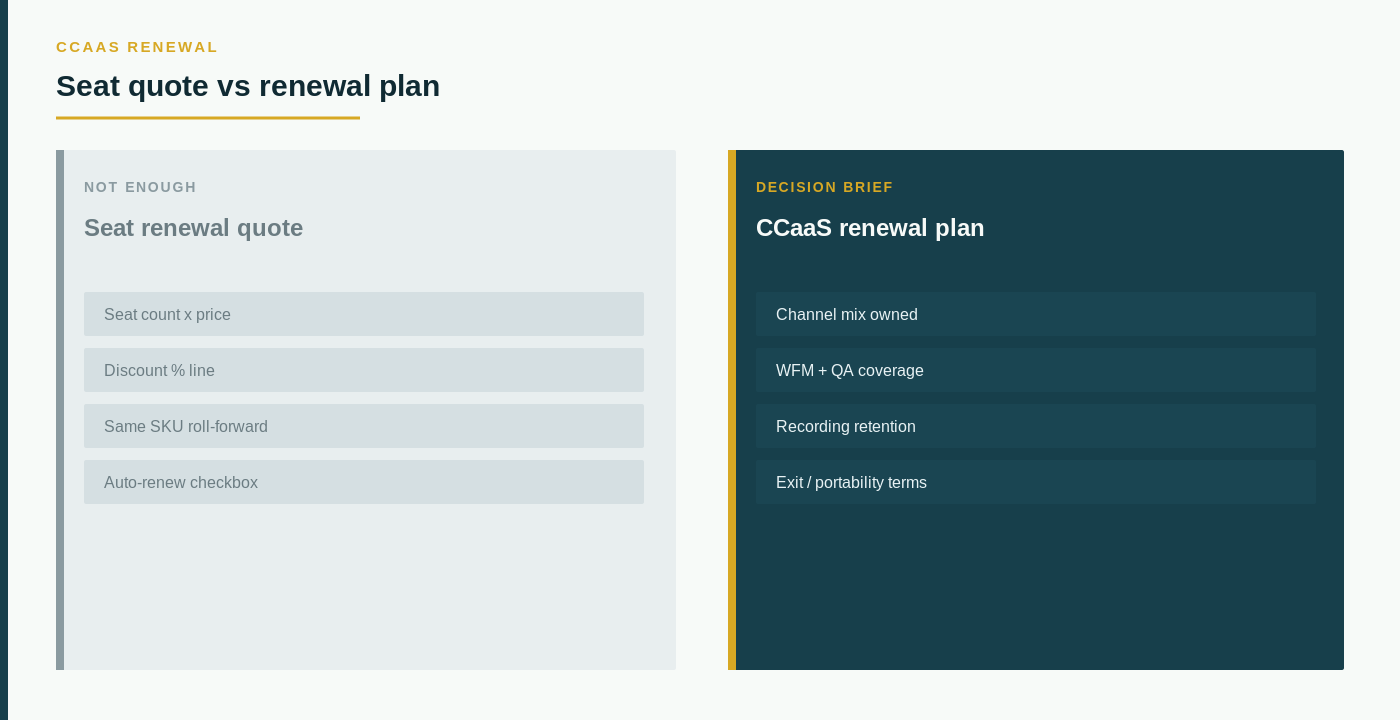
Concise answer: A seat renewal is a commercial event. It restates how many agent, supervisor, or add-on licenses you intend to keep paying for. A CCaaS renewal plan is an operating decision: which contact-center work must continue, which channels and integrations are in scope, who owns quality and workforce processes, and what evidence you will use before you extend, reduce, or change the platform. Treat the seat count as one input. Do not treat it as the plan.
Renewal calendars reward the team that already has a written brief. They punish the team that only has last year's quantity and a reminder from procurement.
The central principle is simple: license quantity is a commercial input, while CCaaS renewal is an operating decision. Those questions are related. They are not interchangeable.
What a seat renewal actually tells you
A seat renewal usually arrives as a quote, an auto-renew notice, or a spreadsheet of named users. It can be useful. It tells you a quantity, a term, and often a list of SKUs that already exist in the environment.
It does not tell you whether those SKUs still match the work.
A seat line may represent:
- Named agents who still take contacts.
- Named users who no longer take contacts but still consume a license.
- Supervisors, quality reviewers, or workforce planners bundled into the same count.
- Channel add-ons that were never turned on.
- Recording, analytics, or routing features that sit on a different commercial line than the agent seat.
A quantity is not a workload map. A named-user list is not a channel inventory. The useful question is not "How many seats do we renew?" It is "Which contact-center outcomes must this platform still support, and what would we accept as proof before we extend the term?"
The meaning of CCaaS page is the right place to reset the category before you argue about seats.
Separate the license event from the renewal plan
A seat renewal does not show whether the platform still fits how the center operates.
Important questions remain open even when the seat count looks familiar:
- Which channels are in production (voice, chat, email, messaging) versus which were purchased and unused?
- Which routing, queue, and hours-of-operation rules still match demand?
- Who owns quality scoring, recording retention, and coaching follow-through?
- Who owns workforce forecasting, shrinkage, and schedule exceptions?
- Which CRM, ticketing, knowledge, and identity integrations are required on day one of the next term?
- What happens if a contact cannot be completed on the current path — escalation, overflow, or after-hours coverage?
- Which data must stay in the contact-center platform, which must leave it, and who can export it?
- What are notice dates, price-protection windows, and customer responsibilities at the end of term?
A seat quote cannot answer these questions because it is not designed to capture them.
Compare the seat quote with the renewal brief
| Decision area | What a seat renewal may show | What the CCaaS renewal plan must document |
|---|---|---|
| Decision identity | A quantity and a term | Whether this is a like-for-like extension, a rightsizing, a channel change, a quality/WFM add, or an exit |
| Work inventory | Named users or license SKUs | Contact types, volumes by channel, peak windows, languages, and work that must not break |
| Operating model | Sometimes a product family | Who owns routing, quality, workforce, knowledge, and incident escalation |
| Integrations | An add-on line or nothing | Systems of record, identity, recording destinations, and data-export paths that must survive the term |
| Evidence | Last year's count | Recorded proofs for routing, reporting, retention, and handoff — not a demo of seats |
| Timing | Auto-renew date | Notice, testing, training, and a decision date that is earlier than the commercial deadline |
Two platforms can quote the same seat count and still be incomparable. One may include supervisor tools in the agent SKU. Another may split quality, workforce, and recording onto separate lines. Counts without a brief produce false equals.
Inventory the work before you accept the quantity
Start with the work, not the license file.
Write one record for the current contact-center environment:
- Why the center exists for this business (sales, support, billing, clinical scheduling, field dispatch — describe the work, not a brand).
- Which contact types are in scope and which are out of scope.
- Which channels are live, which are planned, and which were licensed but never used.
- Who owns quality management, including sampling, scoring, and coaching closure.
- Who owns workforce management, including forecast owners and exception owners.
- Which reports leadership actually uses to run the week.
- Which integrations cannot fail on the first day of the next term.
- Which retention, recording, and access rules apply to this environment.
Do not put recordings, customer records, agent credentials, or raw quality files into the first brief. Capture owners, locations of the data, and the evidence you will request later.
The CCaaS implementation readiness checklist is useful even at renewal, because a renewal that adds channels or changes routing is still an implementation event. The CCaaS providers overview and the CCaaS platform comparison page belong after the brief exists, not before.
Questions that belong in the first renewal meeting
Ask the incumbent — and any challenger — to show, not describe:
- Which licenses map to people who still take contacts, and which map to unused or duplicate seats.
- How routing, hours, and overflow behave during a named peak, with a report from that peak rather than a slide.
- Who can change a quality form, a recording retention period, or a workforce exception without opening a project.
- What evidence they would produce if you asked tomorrow for a channel-by-channel volume, a failed-handoff count, and an unused-SKU list.
- What happens to recordings, transcripts, and historical reporting if the term is not extended.
If those answers are a seat spreadsheet and a promised discount week, you do not have a CCaaS renewal plan. You have a seat renewal.
What this page is not
This page is not a product comparison, not a quote, and not a claim that any center already completed this review. It is not legal advice, not a recording-retention policy, and not a workforce forecast. It does not name suppliers. It does not treat a seat discount as proof that the operating model still fits.
Use the CCaaS meaning page to keep the category straight, write the work and owners, then request the next conversation. If you need a structured intake after the brief exists, use contact. Related buying questions also sit on FAQs.