
A conversation that starts with a spend chart — “here is last month’s bill,” “the dashboard already trends,” “FinOps is included” — usually fails at the first unowned SKU, the first shared cost no one will take, or the first anomaly no one may stop, not at the first bar. A spend chart is a picture of spend. It is not cloud FinOps readiness.
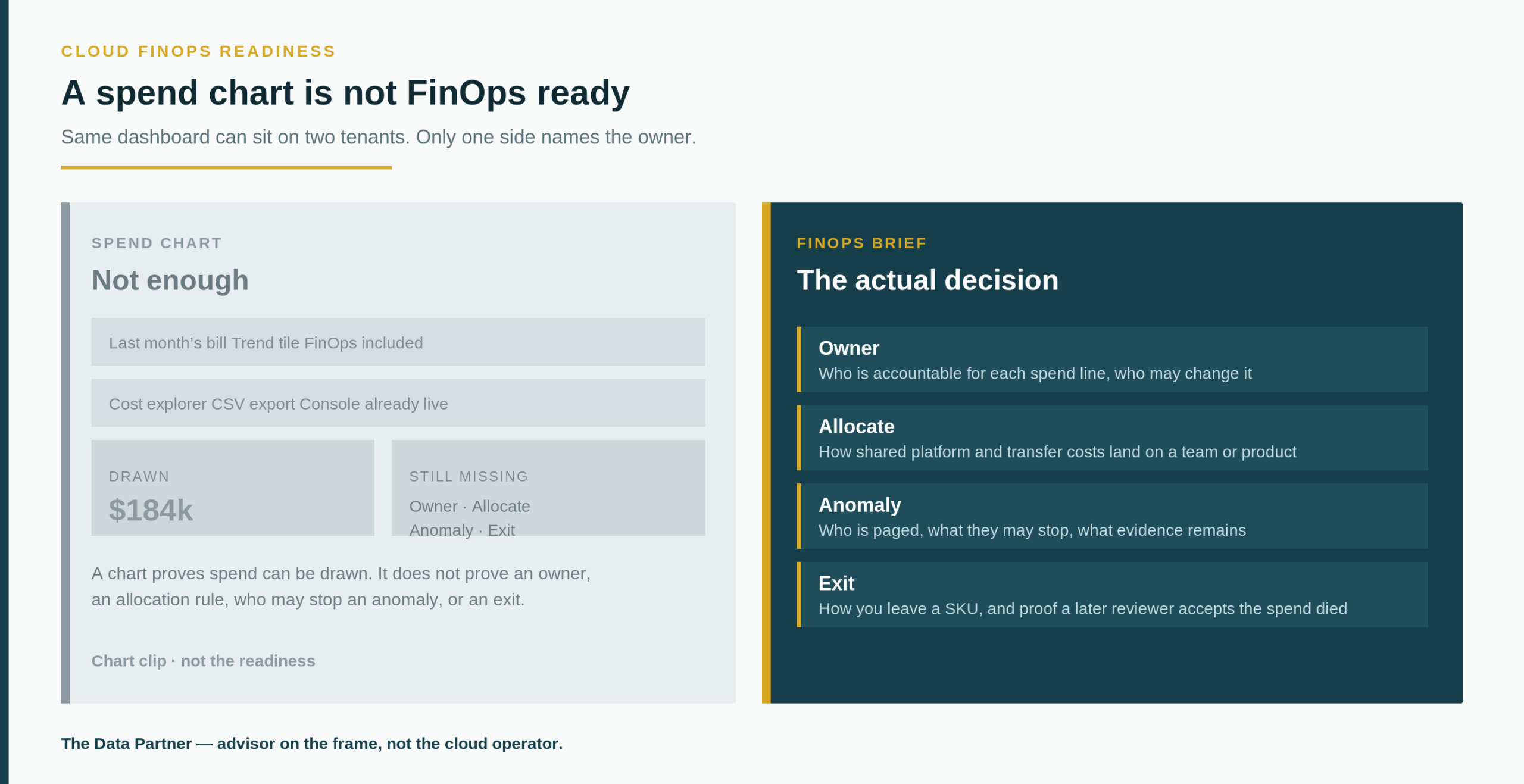
Cloud FinOps readiness names who owns each spend line, how shared cost is allocated, who may stop an anomaly, and how you prove a SKU can be exited. It does not name a chart. It does not name a billing export. Two tenants can share the same dashboard and still leave every line unowned, treat allocation as a hope, page no one on a runaway meter, and have nothing that proves a service was turned off.
The usual shortcut collapses FinOps into a still. Someone opens the cost explorer, captures last month, and treats that image as readiness. The owner is still “finance and engineering will align.” Shared platforms have no allocation rule. Anomalies close themselves. Exit is still a slide about portability. You have a spend chart. You do not have FinOps readiness.
That is why the live cloud meaning page starts with placement, responsibility, and exit rather than a brand wall. This note does not replace that page. It is the FinOps-readiness reminder that sits beside it: a chart is not the operating practice. When the next job is still whether a move, a stay, or an exit is even the work, use the cloud assessment after the owner, allocate, anomaly, and exit rows are written, not instead of them. Score written answers on the cloud provider evaluation. If the next argument is “the provider secures the cloud,” use the cloud security responsibility matrix — that is identities, keys, and logs, not a spend line. When the real choice is stay on the floor versus place a workload with an operator, use the colocation provider brief rather than treating a cost chart as the category.
What FinOps readiness is not
- It is not a spend chart. A bar or a trend proves spend can be drawn. It does not prove an owner, an allocation rule, or an exit.
- It is not a “FinOps included” checkbox. A dashboard tile is not a named person who may stop a runaway SKU.
- It is not a billing export. A CSV is a payment file. It is not allocation, and it is not an anomaly path.
- It is not a shared-responsibility cartoon. Identities and keys are the security-matrix page’s job. They are not a spend owner.
- It is not a logo wall. A familiar hyperscaler mark does not write your allocation or your exit proof.
What to write before the chart
- Owner: who is accountable for each spend line, and who may change it without a second eye.
- Allocate: how shared platforms, support, and data-transfer costs land on a team or a product. A round percentage is not that rule.
- Anomaly: who is paged, what they may stop, and what evidence remains when they do.
- Exit: how you leave a SKU, who owns the extraction, and what a later reviewer would treat as proof the spend died.
- Remainder: what finance still owns, what engineering still owns, and who accepts residual risk on an unowned meter.
Questions that belong in the first meeting
Ask the incumbent or a challenger to show, not describe:
- Which spend lines they treated as owned, and which they treated as “the dashboard will surface it.”
- How a shared platform cost is allocated, and an example month where the rule moved a number a team would accept.
- Who may stop a runaway SKU, including after hours, and what they leave behind.
- What a later reviewer would receive as exit proof — not a spend chart and a promised FinOps week.
If those answers are a spend chart and a promised FinOps week, you do not have cloud FinOps readiness. You have a picture of spend.
What this page is not
This is not a platform ranking, not a FinOps product sheet, and not a claim that The Data Partner already operates anyone’s cloud spend after a catalog view. The Data Partner is the advisor on the decision frame, not the cloud operator and not the billing vendor. It is not a reprint of the live meaning page, the live assessment, the live provider evaluation, the live security-responsibility matrix, or the live colocation brief. Skip incentive talk and skip any suggestion that a spend chart defines FinOps readiness. Write the owner, the allocation, the anomaly path, and the exit. Then use the live companions, or contact The Data Partner on that packet. Broader buying questions sit on the FAQs page.